
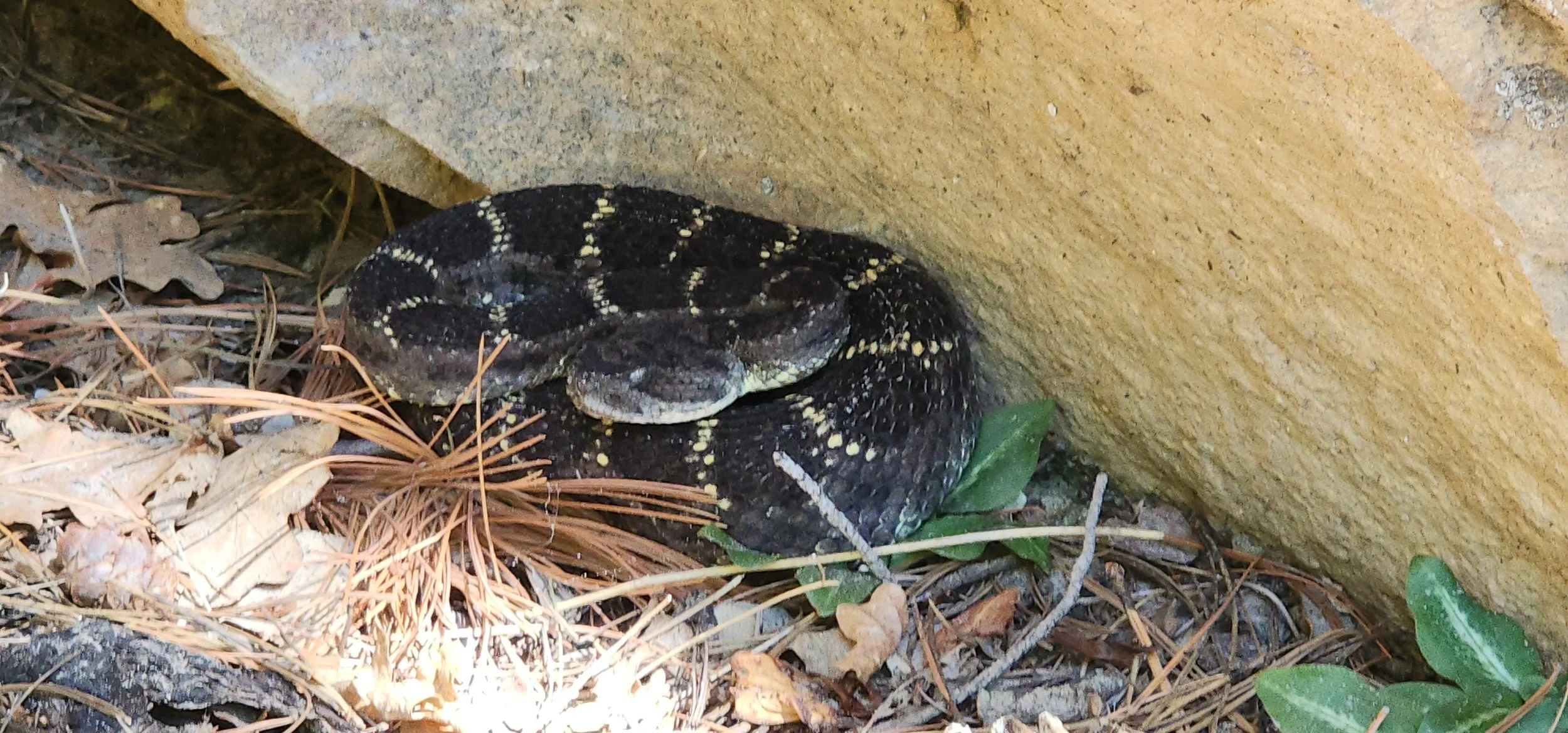
Arizona Black Rattlesnake (Crotalus cerberus)
The Arizona Black Rattlesnake is a robust, well-camouflaged pit viper native to higher elevation regions of central and northern Arizona. It is most commonly found in mountainous habitats and relies on potent hemotoxic venom to subdue small mammals. Envenomation from this species is a serious medical emergency that requires immediate hospital treatment and antivenom administration.
Identification & Markings
The Arizona Black Rattlesnake has a broad, triangular head that is clearly distinct from its narrower neck. Like other pit vipers, it possesses vertical, elliptical pupils as well as heat-sensing loreal pits located between the eyes and nostrils, which allow it to detect warm-blooded prey.
Juveniles typically display a lighter gray or brown background coloration with darker blotches and distinct facial markings, including a dark stripe running from the eye downward. As they mature, their coloration darkens considerably. Adults often appear almost entirely jet-black or very dark brown, though some may retain faint, lighter crossbands along the body.
The tail ends in a segmented rattle, as is characteristic of rattlesnakes. Unlike the similar-looking Black-tailed Rattlesnake (Crotalus molossus), the Arizona Black Rattlesnake’s tail coloration generally matches the rest of its dark body rather than appearing distinctly contrasting.
Size & Striking Distance
Adults of this species typically reach lengths of 36 to 42 inches (91 to 107 cm), although some individuals may grow slightly larger. Like all rattlesnakes, striking ability is limited to a coiled posture. From this position, they can strike approximately one-third to one-half of their total body length, resulting in an effective strike range of roughly 1 to 1.5 feet.
Location & Habitat
This species is primarily found in montane regions of Arizona, particularly in central parts of the state. It is commonly associated with the Mogollon Rim, the Tonto Basin, and mountain ranges north of Phoenix, including the Mazatzal, Bradshaw, and Black Hills ranges.
The Arizona Black Rattlesnake prefers rocky slopes, wooded areas, and high-elevation coniferous forests. Its dark coloration provides excellent camouflage among shadows, rocks, and leaf litter in these environments.
Eating Habits
The Arizona Black Rattlesnake is an ambush predator that relies on concealment to capture prey. It often waits in rock crevices, beneath logs, or hidden within leaf litter, using its heat-sensing pits to detect passing warm-blooded animals. When prey comes within range, it strikes, injects venom, and releases the animal. It then tracks the scent trail until the prey succumbs, after which it consumes the meal.
Its diet primarily consists of small mammals such as mice, rats (including woodrats), small rabbits, and squirrels, though it will also feed on lizards when available.
Venom Danger
The venom of the Arizona Black Rattlesnake is primarily hemotoxic, meaning it damages red blood cells, interferes with normal blood clotting, and can cause severe tissue and muscle destruction. While not considered the most potent rattlesnake venom, this species is capable of delivering a relatively large venom yield. A bite can result in rapid swelling, intense pain, bruising, and tissue necrosis. Without prompt medical treatment, serious complications may occur and can become life-threatening.
What To Do If Bitten
A rattlesnake bite must be treated as a medical emergency. Immediate action is essential to reduce risk of severe injury.
After a bite, the first step is to move away from the snake to prevent any additional strikes. Emergency services should be contacted immediately by calling 911, or the victim should be transported to the nearest hospital as quickly as possible. It is important not to attempt self-transport when avoidable. The affected person should remain as calm and still as possible, since movement can accelerate venom spread. If practical, the bitten limb should be kept below heart level, and any tight items such as rings, watches, or restrictive clothing should be removed before swelling begins.
Outdated first aid methods should never be used. Tourniquets, ice, cutting the wound, or attempting to suck out venom can significantly worsen tissue damage and increase the risk of serious complications, including possible amputation. The snake should not be chased, handled, or killed, as this greatly increases the risk of another bite and delays critical medical treatment.