
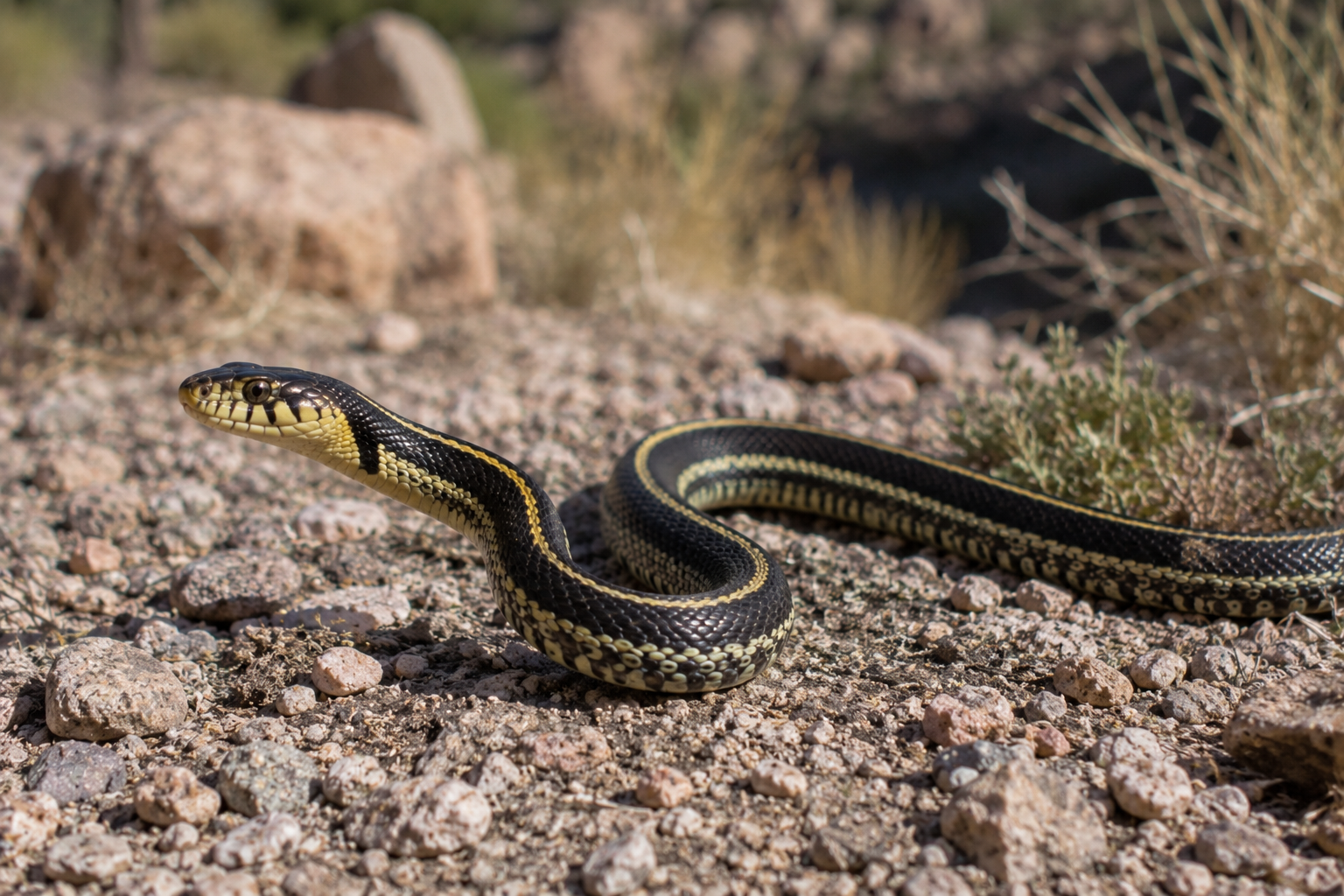
Blackneck Garter Snake (Thamnophis cyrtopsis)
Common Names: Blackneck Garter Snake, Black-neck Garter Snake
The Blackneck Garter Snake (Thamnophis cyrtopsis) is a nonvenomous species native to the southwestern United States, Mexico, and Guatemala. It is commonly associated with streams, rivers, ponds, and other water sources, though it occupies a variety of habitats across its range.
Description
Three subspecies of the Blackneck Garter Snake are currently recognized. Two of the most commonly referenced subspecies are the Western Blackneck Garter Snake and the Eastern Blackneck Garter Snake.
Western Blackneck Garter Snake (Thamnophis cyrtopsis cyrtopsis)
The Western Blackneck Garter Snake is the larger of the two forms and may reach lengths of approximately 42 inches (107 cm). Its body is typically dark olive to brownish in color, marked by a bright yellow to orange stripe running along the center of the back. The underside is usually cream-colored or light gray.
This subspecies is strongly associated with aquatic environments and is frequently found in or near rivers, streams, and other permanent water sources. Its diet commonly includes small fish, tadpoles, and other aquatic prey.
Eastern Blackneck Garter Snake (Thamnophis cyrtopsis ocellatus)
The Eastern Blackneck Garter Snake is generally smaller, often measuring less than 20 inches (51 cm) in total length. It typically displays three light-colored stripes against a darker background, with orange or yellow-orange coloration often visible along the body.
Unlike its western relative, this subspecies is more often encountered on land, although it usually remains close to water.
Range
The Blackneck Garter Snake occurs throughout portions of Arizona and other areas of the southwestern United States. Its range extends south through Mexico and into Guatemala.
Habitat
This species is most often found near reliable water sources. Habitats include desert scrublands, grasslands, chaparral, woodlands, and riparian corridors.
Behavior
Blackneck Garter Snakes are primarily active during daylight hours but may also be seen at dawn, dusk, or occasionally at night. In colder regions, they become inactive during the winter months and typically breed during late spring or summer.
Diet
An active predator, the Blackneck Garter Snake feeds on a variety of small animals. Common prey includes fish, amphibians, earthworms, aquatic invertebrates, and occasionally other snakes.