
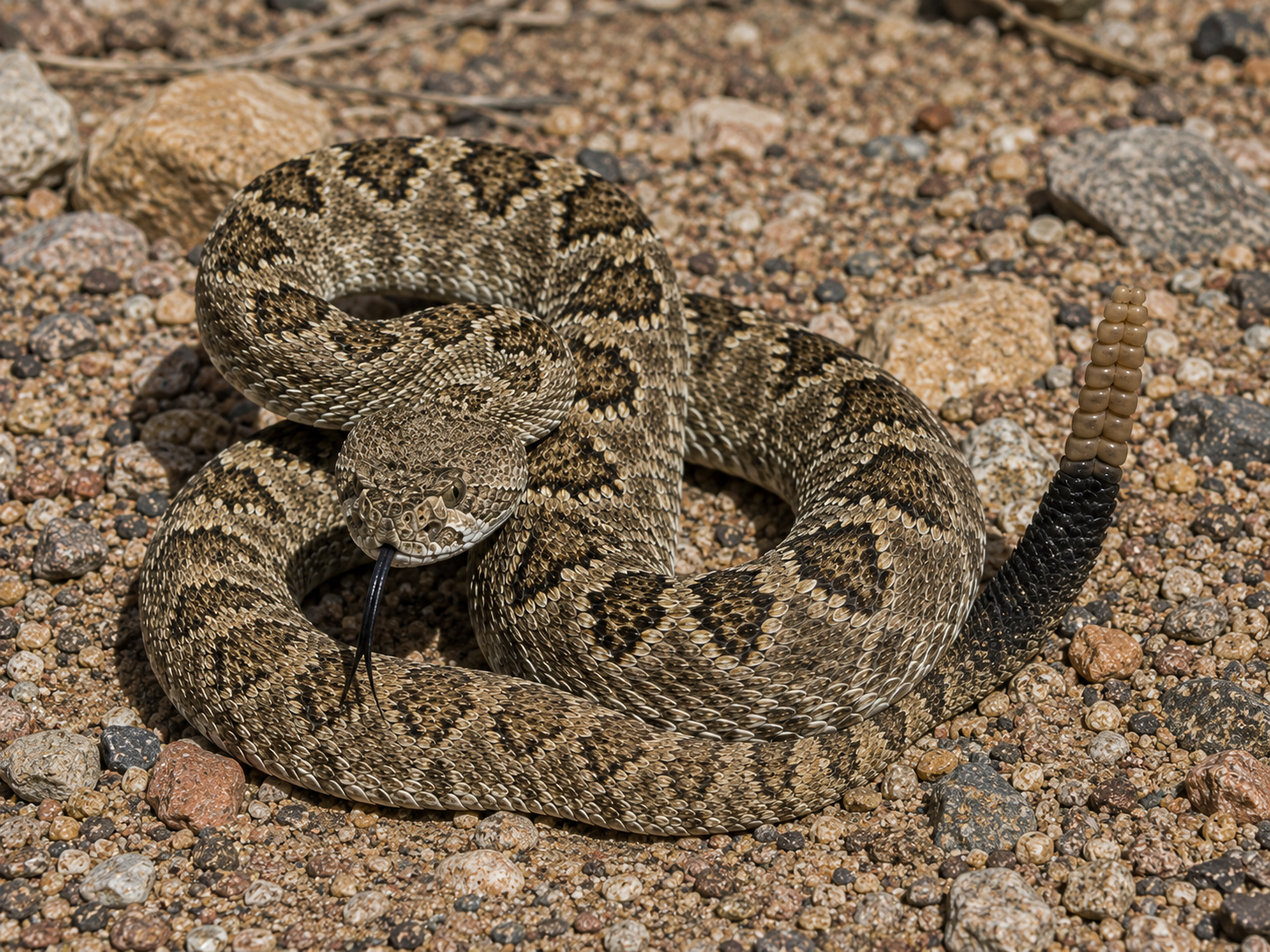
Arizona Blacktail Rattlesnake (Crotalus molossus)
Identification: Head and Body Markings
The Arizona Blacktail Rattlesnake is one of the most recognizable rattlesnake species found in the American Southwest. Although the common name is often applied to the Northern Black-tailed Rattlesnake (Crotalus molossus), Arizona is also home to the closely related Arizona Black Rattlesnake (Crotalus cerberus). Both species share many characteristics but differ in coloration and habitat preferences.
The Northern Black-tailed Rattlesnake is best identified by the solid black coloration found on the final section of the tail immediately before the rattle. Body coloration varies widely and may range from olive-gray and tan to yellowish-brown or dark brown. The back is typically marked with dark, diamond-shaped or hexagonal blotches that often contain lighter scales near their centers. The head is broad and triangular, featuring a dark stripe that extends diagonally from the eye toward the corner of the mouth. Like other pit vipers, it possesses heat-sensitive pits located between the eyes and nostrils that help detect warm-blooded prey.
The Arizona Black Rattlesnake is generally associated with higher elevations and is much darker in appearance. Mature individuals are commonly dark brown to nearly black, with pale-edged hexagonal markings visible along the body. Juveniles are considerably lighter, often displaying a gray background color that darkens with age.
Size and Strike Distance
Adult Arizona Blacktail Rattlesnakes typically measure between 30 and 49 inches in length, although exceptionally large individuals may approach or slightly exceed 4 feet. Males are often somewhat larger than females.
Like other rattlesnake species, they strike by rapidly extending the front portion of the body from a coiled position. Most defensive strikes reach approximately one-third to one-half of the snake's total body length. For a snake measuring around 3 feet long, the effective strike range is generally between 12 and 18 inches. Despite common misconceptions, rattlesnakes cannot leap entirely off the ground during a strike.
Eating Habits
Arizona Blacktail Rattlesnakes are ambush predators that rely heavily on camouflage, scent detection, and heat-sensing pits to locate prey. Their forked tongue collects scent particles from the environment, which are analyzed through the Jacobson's organ, allowing the snake to track potential food sources.
Their diet consists primarily of small mammals, including mice, woodrats, ground squirrels, and rabbits. They will also consume birds and lizards when the opportunity arises. Unlike many rattlesnake species, Blacktail Rattlesnakes are capable climbers and may occasionally be observed hunting in low shrubs or the lower branches of trees.
When prey is located, the snake delivers a venomous strike and typically releases the animal rather than holding onto it. The snake then follows the scent trail left by the envenomated prey until it succumbs to the venom.
Location and Habitat
The Northern Black-tailed Rattlesnake occupies a wide range of habitats throughout southern Arizona. It can be found from lower-elevation Sonoran Desert environments to rocky foothills, canyons, and mountain slopes within the isolated mountain ranges known as the Sky Islands of southeastern Arizona.
The Arizona Black Rattlesnake is largely restricted to cooler, higher-elevation habitats. It is commonly found in chaparral communities, pine-oak woodlands, and mountainous forests across central and eastern Arizona. Strongholds for this species include the Mogollon Rim region and the White Mountains.
Venom and Deadliness
The venom of the Arizona Blacktail Rattlesnake is primarily hemotoxic in nature. It damages blood cells, interferes with normal clotting functions, and can cause significant tissue injury and muscle damage around the bite site.
Although its venom is generally considered less toxic than that of the Western Diamondback Rattlesnake, these snakes possess relatively large venom glands and are capable of delivering substantial amounts of venom. Serious medical complications can occur without treatment.
Human fatalities from Blacktail Rattlesnake bites are extremely uncommon, particularly when modern medical care and antivenom are administered promptly. Nevertheless, every bite should be treated as a potentially serious medical emergency.
What to Do If Bitten
If bitten by an Arizona Blacktail Rattlesnake, move to a safe location immediately to avoid additional strikes. Do not attempt to capture, kill, or handle the snake, as doing so greatly increases the risk of further injury.
Contact emergency medical services by calling 911 as soon as possible, and arrange transportation to the nearest hospital. Remove rings, watches, bracelets, or tight-fitting clothing from the affected limb before swelling begins.
Keep the bitten area as still as possible and position it at or slightly below heart level. Limiting movement may help slow the circulation of venom through the body until professional medical treatment is available.
What Not to Do
Several traditional snakebite treatments are ineffective and may increase the severity of injury. Do not apply ice to the bite area, as this can worsen tissue damage. Tourniquets should not be used because they can restrict blood flow and lead to serious complications. Attempting to cut the wound, suck out venom, or use commercial extraction devices is also not recommended.
Avoid taking medications such as aspirin or ibuprofen unless directed by a medical professional, as these drugs can affect blood clotting and may increase bleeding risks associated with envenomation. Rapid transport to a medical facility remains the most effective response to any rattlesnake bite.