
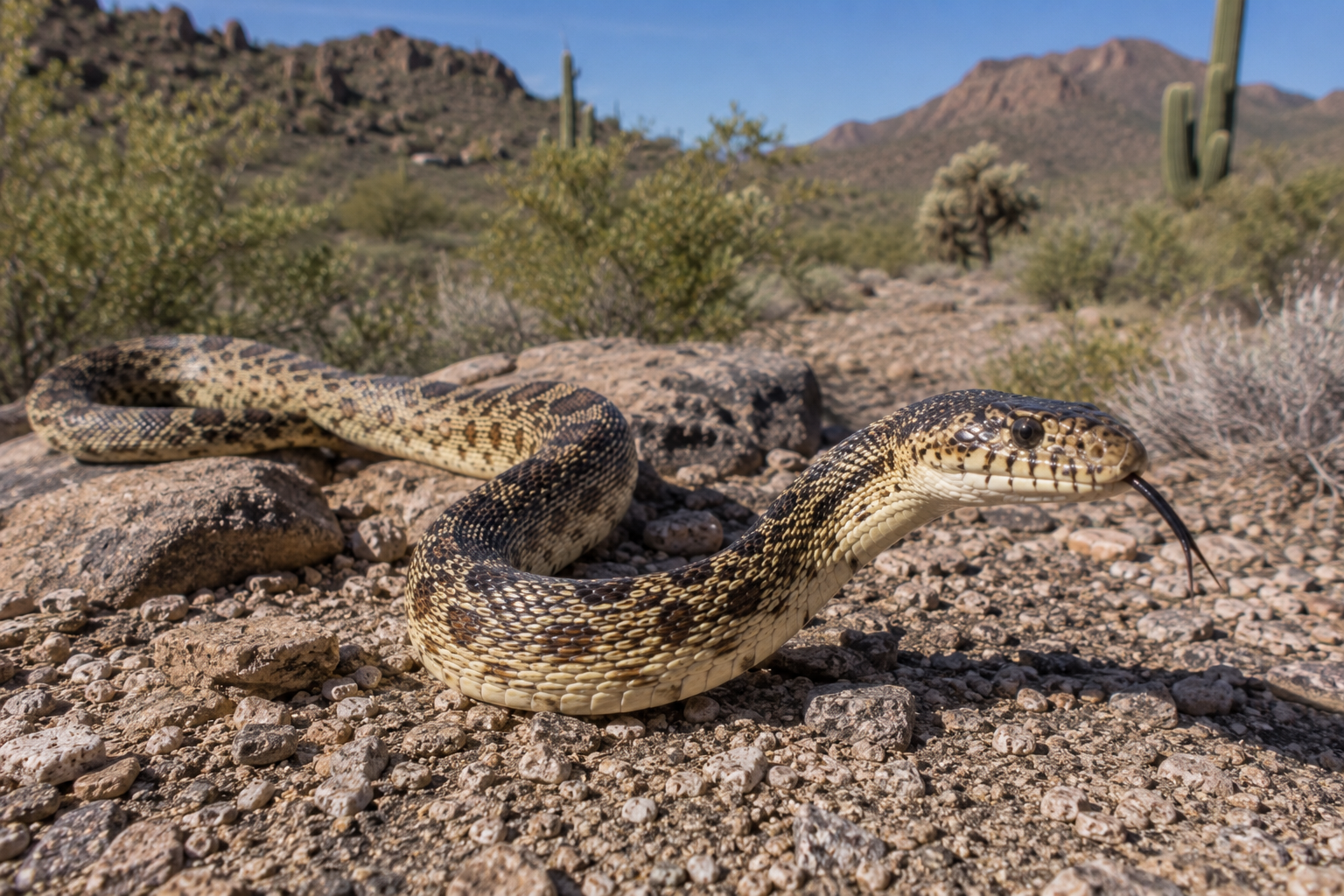
Gopher Snake (Pituophis Catenifer)
The gopher snake is Arizona's largest and one of its most frequently encountered snake species. Most adults measure between 4 and 6 feet long, although exceptionally large individuals can exceed 7 feet. Despite their impressive size and intimidating defensive displays, gopher snakes are non-venomous and pose little threat to people.
Because they can imitate some rattlesnake behaviors, they are often misidentified by homeowners and outdoor enthusiasts.
Identification
Gopher snakes typically have a light tan, cream, or yellowish background color marked with large dark blotches running down the back. These markings may be black, dark brown, or reddish-brown depending on the individual and location.
One of the easiest ways to distinguish a gopher snake from a rattlesnake is by examining the tail. A gopher snake's tail gradually narrows to a pointed tip and lacks a rattle.
Defensive Behavior
When feeling threatened, gopher snakes put on an impressive display intended to discourage predators. They may:
Produce a loud, forceful hiss.
Flatten their head and neck to appear larger.
Vibrate their tail rapidly against dry vegetation or debris.
These behaviors can closely resemble those of a rattlesnake, but they are purely defensive and do not indicate venom.
Although generally docile, a gopher snake may bite if cornered, handled, or repeatedly disturbed. Such bites can cause minor scratches or punctures but are not venomous.
Habitat
Gopher snakes are highly adaptable and occur throughout Arizona. They can be found in deserts, grasslands, rocky hillsides, agricultural areas, parks, golf courses, and residential neighborhoods. Their ability to thrive in both natural and developed environments makes them a common sight across the state.
Diet
As powerful constrictors, gopher snakes play an important role in controlling rodent populations. Their diet consists primarily of small mammals such as mice, rats, gophers, and young rabbits. They may also consume birds, eggs, and other small vertebrates when available.
Gopher Snake vs. Rattlesnake
Several characteristics can help distinguish a gopher snake from a rattlesnake:
Head Shape
Gopher Snake: Head is relatively narrow and blends smoothly into the neck.
Rattlesnake: Head is noticeably broader than the neck, creating a distinct triangular appearance.
Tail
Gopher Snake: Long, slender tail that tapers gradually to a point.
Rattlesnake: Shorter, thicker tail ending in a segmented rattle.
Resting Posture
Gopher Snake: Often rests in a loose, elongated coil.
Rattlesnake: Frequently forms a tighter, more compact coil when at rest.
While these features can be helpful, it is always best to observe snakes from a safe distance and avoid handling any wild snake unless you can identify it with complete confidence.