
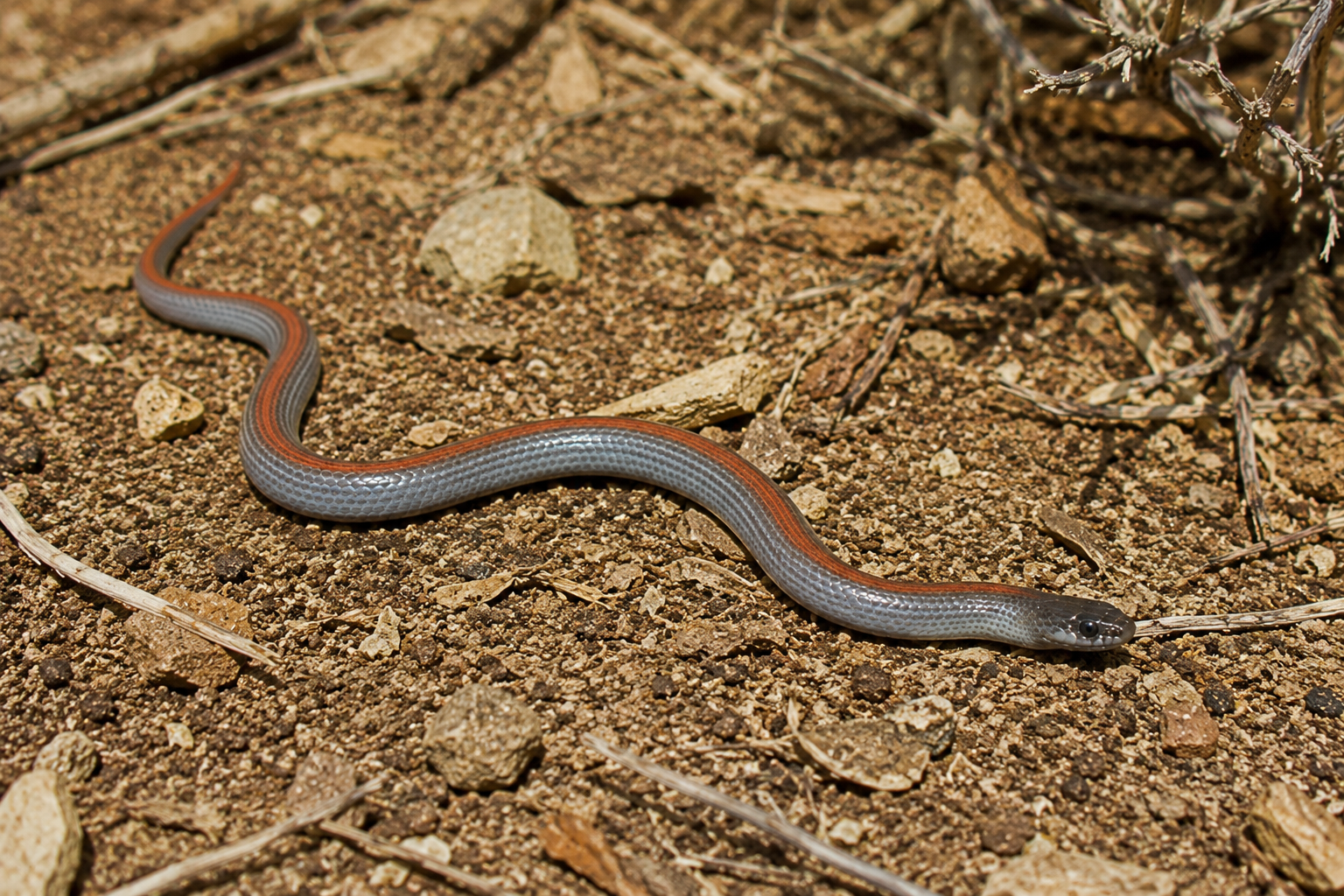
Western Ground Snake (Sonora semiannulata)
Identification
The Western Ground Snake, sometimes called the Variable Ground Snake, is a small, secretive, non-venomous species commonly found throughout Arizona's deserts, grasslands, and even suburban landscapes. Although its appearance can vary dramatically from one individual to another, several characteristics make it recognizable in the field.
Adults typically measure between 8 and 19 inches (20–48 cm) in total length. They have a small, streamlined head that is only slightly wider than the neck, along with relatively small eyes that contain round pupils. Coloration is extremely variable, which is why the species is often referred to as the Variable Ground Snake. Individuals may appear plain, striped, banded, or patterned in various ways. Their background color can range from gray, tan, olive, and brown to orange or deep red. Some snakes display a dark-colored cap on the head, while others have a bright orange or reddish stripe running down the back or distinct black crossbands along the body.
One of the most reliable identification features is the belly, which is typically unmarked and uniform in color. The underside is usually cream, white, or pale yellow, helping distinguish this species from several similar-looking snakes found in the Southwest.
Weight
Western Ground Snakes are extremely slender, pencil-like reptiles. Because of their small size and secretive lifestyle, they weigh very little. Most adults weigh only a few grams, generally ranging from about 2 to 10 grams, depending on their size and whether a female is carrying eggs.
Diet
Western Ground Snakes are active hunters that spend much of their time searching for food beneath loose soil, leaf litter, rocks, and other ground cover. During the hottest parts of the year, they are most active at night or during the cooler hours of dusk. Using their narrow snouts, they probe through debris and soil in search of prey.
Their diet consists primarily of small invertebrates. Common prey items include spiders, scorpions, centipedes, crickets, grasshoppers, insect larvae, and other small arthropods. By feeding on many species that are often considered household or garden pests, these snakes provide a natural form of pest control in both wild and developed environments.
Defense Mechanisms
Western Ground Snakes are gentle and non-aggressive animals that pose no danger to people or pets. They rarely attempt to bite, even when handled. Instead, they rely on avoidance and concealment to protect themselves from predators.
When threatened, they typically try to escape quickly by slipping into loose soil, leaf litter, rock crevices, or other tight hiding places. If captured or cornered, they may release a foul-smelling musk as a deterrent. Their small size, secretive nature, and ability to disappear into narrow spaces are their primary means of defense.
Reproduction
Western Ground Snakes reproduce by laying eggs rather than giving birth to live young. During late spring and summer, females deposit a clutch of approximately 1 to 6 eggs in protected locations such as moist soil, beneath rocks, or within sheltered crevices. The eggs develop naturally underground, where temperature and moisture conditions help support incubation.
When the young hatch, they are exceptionally small, measuring only about 3 inches (8 cm) in length. Despite their tiny size, hatchlings are fully independent and begin hunting small prey shortly after emerging.
Lifespan
In the wild, Western Ground Snakes typically live between 1 and 7 years. However, individuals living in ideal conditions with fewer predators and minimal habitat disturbance may survive considerably longer. Some reports suggest that the species can live up to 10 years, particularly in protected environments or captivity.