
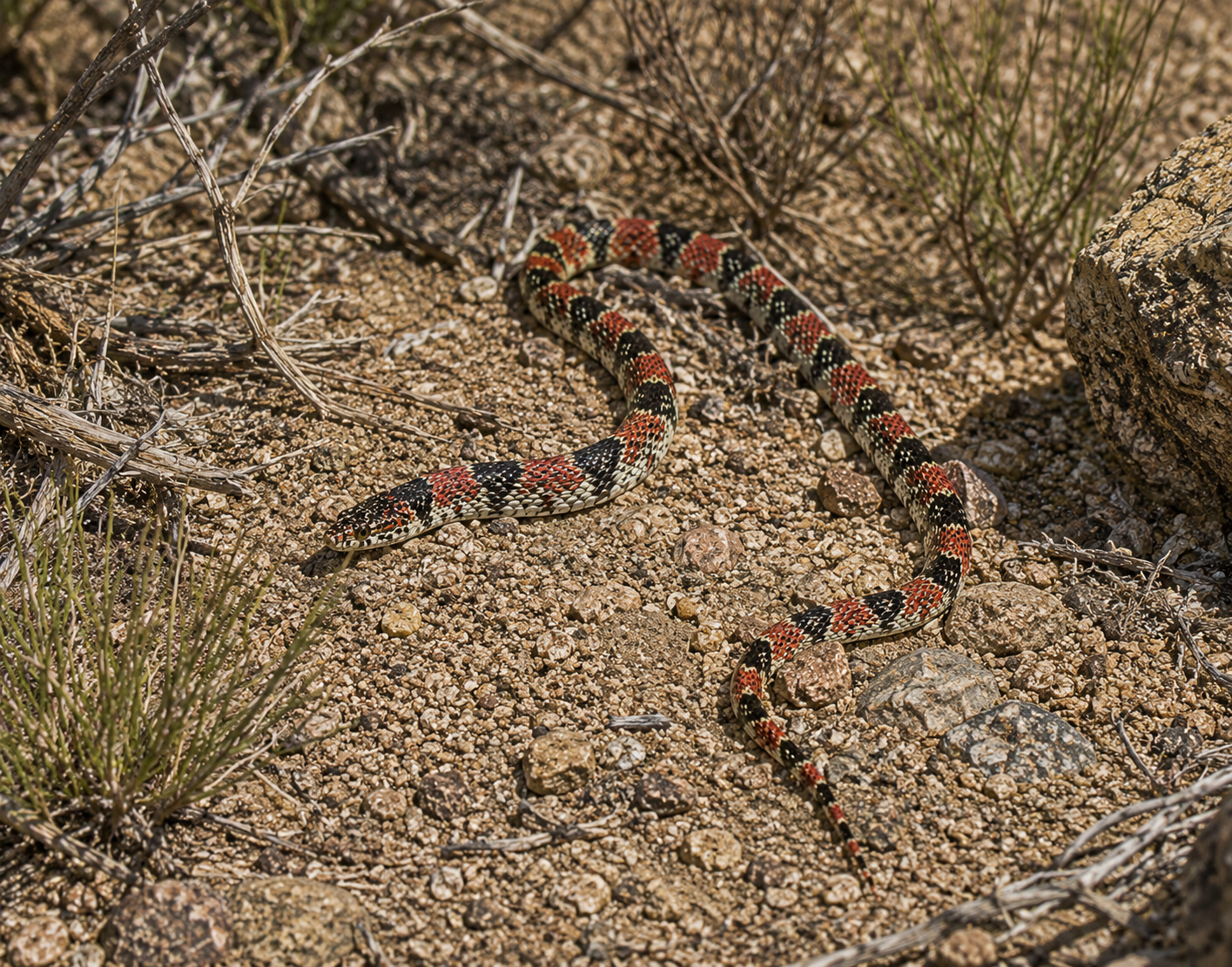
Long-nosed Snake (Rhinocheilus lecontei)
The Long-nosed Snake is a harmless, non-venomous species commonly found throughout Arizona and much of the American Southwest. This secretive desert snake is best known for its distinctive elongated snout and striking color patterns. Primarily active at night, it spends much of its life hidden beneath loose soil, sand, rocks, or other surface cover, where it searches for food and avoids the intense daytime heat.
Identification
The most recognizable feature of the Long-nosed Snake is its elongated, slightly upturned snout. This specialized nose helps the snake burrow through loose soil and uncover hidden prey, including lizard eggs. Most individuals display a bold pattern of black, white or yellow, and red to pinkish-orange bands or saddles along the body. Some specimens, however, may lack the red or orange coloration altogether.
Although its coloration can cause confusion with the venomous Sonoran Coral snake, the pattern is noticeably different. On a Long-nosed Snake, the colored markings typically do not wrap completely around the body, and the underside is usually a uniform cream or yellow color. Additional identifying features include a slightly recessed lower jaw, often described as "countersunk," reddish or orange eyes, and distinctive white or gray flecking within the black markings that gives the pattern a speckled or pixelated appearance.
Defensive Behavior
Long-nosed Snakes are generally docile and rarely attempt to bite when threatened. Instead, they rely on a variety of defensive displays designed to discourage predators without direct confrontation.
One of their most common responses is rapidly vibrating the tail, which can create a rattling sound when the tail strikes dry vegetation or leaf litter. If the threat persists, the snake may release a strong-smelling mixture of musk and fecal material from the vent. In extreme situations, Long-nosed Snakes are capable of everting part of the cloaca and releasing small amounts of blood, creating an unpleasant experience for potential predators and increasing their chances of escape.
Diet
Long-nosed Snakes are carnivorous and actively search for prey rather than waiting in ambush. Lizards make up a large portion of their diet, particularly whiptail lizards, and they are also known to consume lizard eggs whenever available.
Their diet may additionally include insects, small rodents, and other snakes. Smaller prey is usually subdued through direct capture and restraint, while larger prey may be killed through constriction before being swallowed whole.
Reproduction
Breeding typically occurs during the spring. Like many desert snakes, the Long-nosed Snake is oviparous, meaning females reproduce by laying eggs rather than giving birth to live young.
Females generally deposit a clutch of six to eight eggs in a protected location. The eggs hatch during the late summer monsoon season, producing young snakes that are exceptionally slender and typically measure between 7 and 11 inches in length. Juveniles sometimes lack the red coloration commonly seen in adults, causing them to appear more black-and-white in pattern.
Lifespan
Long-nosed Snakes are believed to have a relatively long lifespan for a snake of their size. In natural conditions, individuals may live approximately 12 to 20 years, although survival depends on factors such as predation, habitat quality, and environmental conditions.
Size and Weight
Adult Long-nosed Snakes are long-bodied and slender in build. Most mature individuals measure between 16 and 30 inches in length, although exceptionally large specimens can reach up to 41 inches.
Despite their length, they remain lightweight snakes. Healthy adults typically weigh between 100 and 350 grams (approximately 0.2 to 0.8 pounds), with weight varying according to age, body condition, and overall size.