
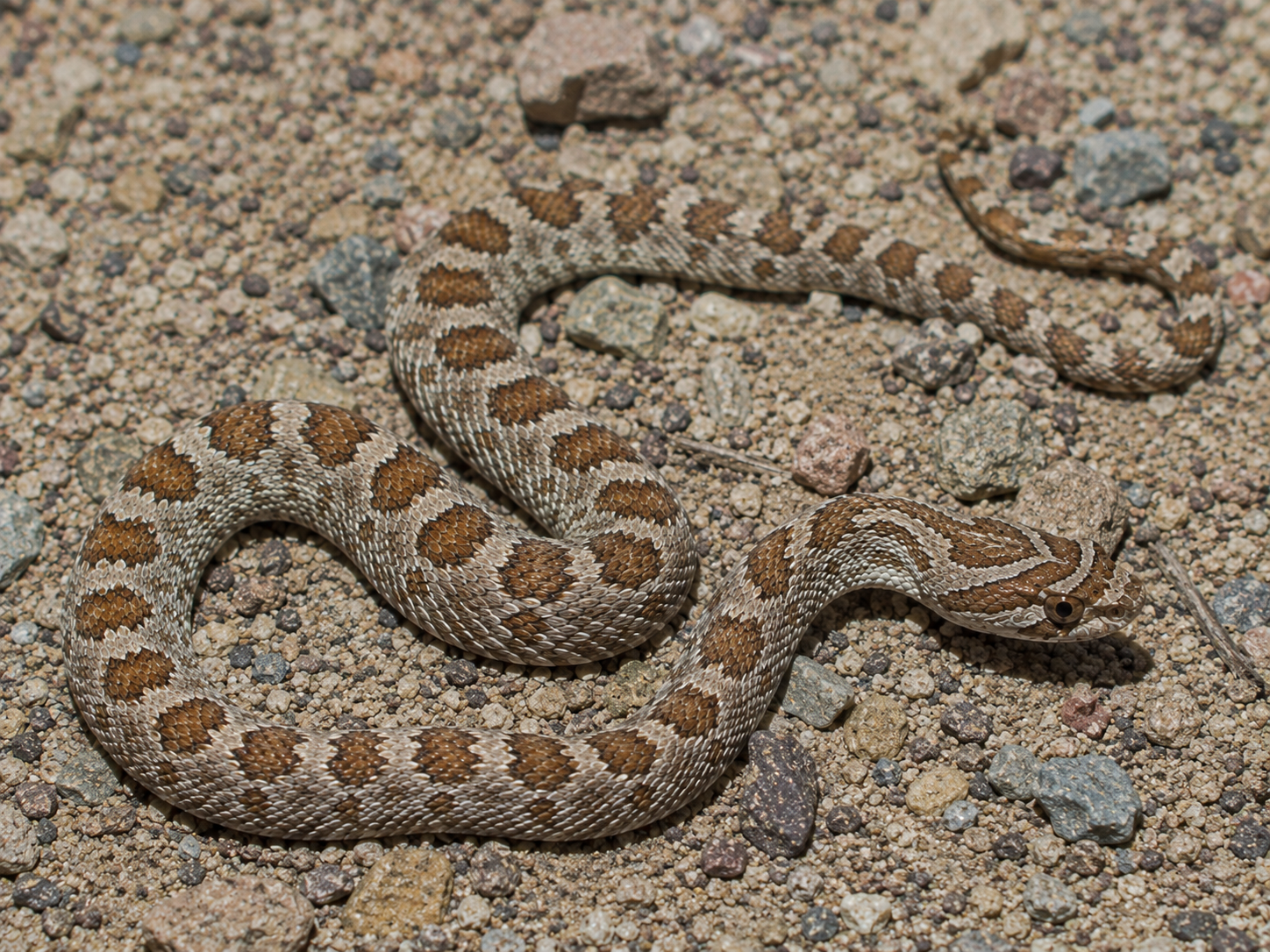
Sonoran Lyresnake (Trimorphodon lambda)
The Sonoran Lyre snake is a secretive, mostly nocturnal species found throughout rocky landscapes of the southwestern United States and northwestern Mexico. It takes its common name from the distinctive V-shaped marking on the top of its head, which resembles the outline of a lyre. Although it possesses rear fangs and a mild venom used to help subdue prey, the venom is not considered medically significant to humans. Sonoran Lyre snakes are generally calm and non-aggressive snakes that are rarely encountered due to their elusive habits and preference for remote, rocky habitats.
Identification
One of the easiest ways to identify a Sonoran Lyre snake is by the dark V-shaped or lyre-like marking on the top of its broad, triangular head. The species has noticeably large eyes with vertical pupils, a feature commonly associated with its nocturnal lifestyle.
The body is typically light tan, gray, or pale brown in color and is marked with a series of darker brown saddle-shaped blotches that run down the length of the back. These markings help the snake blend into the rocky environments it inhabits. Sonoran Lyre snakes are most often found among rocky canyons, steep hillsides covered with boulders, cliffs, and mountain crevices where they spend much of their time concealed during daylight hours.
Size and Weight
Adult Sonoran Lyre snakes generally reach lengths of 36 to 48 inches (3 to 4 feet), although exceptionally large individuals may exceed this range. They have a slender body build compared to many other snakes of similar length. Because they are infrequently encountered and rarely studied in large numbers, precise weight records are limited. Most healthy adults likely weigh anywhere from several ounces to approximately one pound.
Diet
The Sonoran Lyre snake feeds primarily on lizards, which make up the majority of its natural diet. It will also prey upon small rodents, young birds in nests, and bats when opportunities arise. While its venom helps subdue prey, it acts relatively slowly on mammals and birds. As a result, larger prey items are often restrained through constriction before being swallowed.
Defensive Behavior
When threatened, the Sonoran Lyre snake relies on a variety of defensive displays intended to discourage predators. One of its most notable behaviors is rapidly vibrating its tail against leaves, rocks, or other surfaces, creating a buzzing sound that can resemble the warning rattle of a rattlesnake.
If the threat continues, the snake may elevate the front portion of its body, flatten its head to appear larger, and strike defensively. Although it may bite when cornered, it is generally considered a docile species that prefers to avoid confrontation whenever possible.
Reproduction
Breeding typically occurs during the warmer months of the year. Females lay eggs rather than giving birth to live young and may produce clutches containing as many as 20 eggs. Egg deposition generally takes place in late summer, with the eggs being placed in protected locations where they can develop safely until hatching.
Lifespan
The lifespan of Sonoran Lyre snakes in the wild is not well documented because of their secretive nature and the difficulty of long-term studies. However, similarly sized colubrid snakes commonly live between 10 and 15 years in captivity, suggesting that Sonoran Lyre snakes may have a comparable lifespan under favorable conditions.