
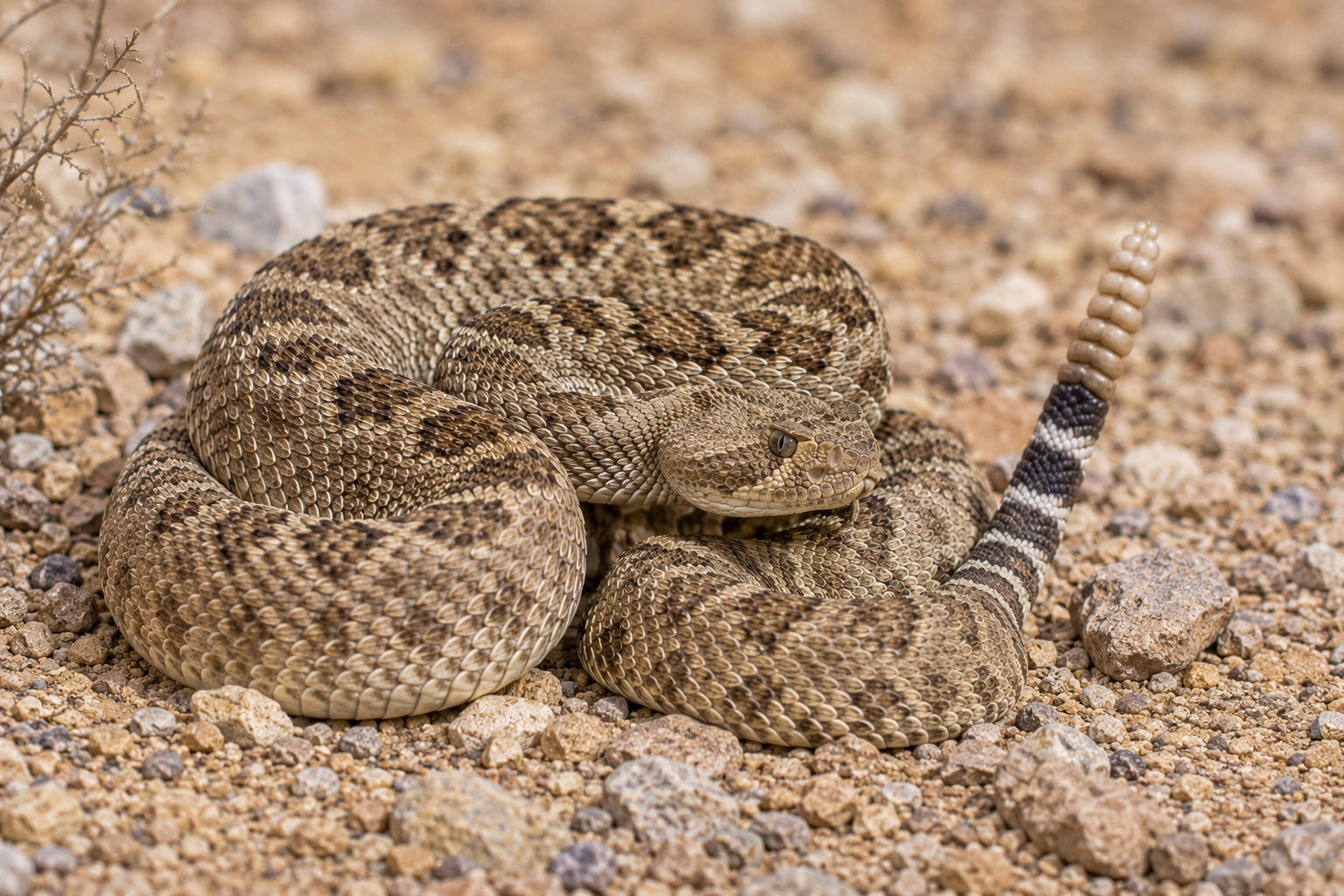
Mojave Rattlesnake (Crotalus scutulatus)
Identification: Head & Body Markings
The Mojave Rattlesnake is a venomous pit viper commonly found throughout portions of Arizona and the southwestern United States. Because of its appearance, it is often confused with the Western Diamondback Rattlesnake, but several characteristics can help distinguish the two species.
The body is marked with a series of dark, well-defined diamond-shaped or nearly diamond-shaped blotches running down the center of the back. Background coloration varies considerably and may include shades of pale green, olive-green, tan, gray, or brown depending on the individual and its habitat.
One of the most useful field marks is the pattern near the tail. Mojave Rattlesnakes display alternating black and light-colored bands, with the light bands typically appearing wider than the dark ones. In many individuals, the section of the tail immediately before the rattle is a solid yellow or tan color rather than black.
A pale stripe extends backward from each eye and continues beyond the corner of the mouth. Unlike some other rattlesnake species, this stripe does not terminate directly above the upper lip. Another identifying feature is found on the top of the head, where several enlarged plate-like scales are present between the eyes.
Size and Strike Mechanics
Adult Mojave Rattlesnakes generally reach lengths between 3 and 4 feet (90–120 cm), although exceptionally large individuals may grow to approximately 50 inches (127 cm).
Like other pit vipers, this species strikes by rapidly extending the front portion of its body from a coiled position. The effective strike distance is typically about one-third to two-thirds of the snake's total body length. As a precaution, maintaining a distance greater than the snake's full body length is recommended whenever one is encountered in the wild.
Habitat in Arizona
Within Arizona, Mojave Rattlesnakes are most often associated with lower-elevation desert habitats. They are particularly common in the southern and western portions of the state, where they occupy open desert landscapes rather than steep mountain terrain.
Preferred habitats include arid scrublands, creosote flats, mesquite-covered areas, desert grasslands, and other sparsely vegetated environments. Their coloration often provides excellent camouflage against the sandy and rocky soils found throughout these regions.
Eating Habits
The Mojave Rattlesnake is primarily an ambush predator. It relies on specialized heat-sensing pits located between the eyes and nostrils to detect warm-blooded prey, even in complete darkness.
Its diet consists mainly of small mammals, including mice, rats, rabbits, and ground squirrels. Lizards and other small reptiles are also consumed when available. After striking and envenomating prey, the snake tracks the animal using scent and heat cues before swallowing it whole.
Venom Toxicity
The Mojave Rattlesnake possesses one of the most medically significant venoms of any snake in North America. In certain populations, particularly those often referred to as "Mojave Greens," the venom contains powerful neurotoxins that can interfere with normal nervous system function. These toxins may be combined with hemotoxic components that damage tissue and disrupt blood clotting mechanisms.
Because venom composition can vary between populations, the effects of a bite may differ depending on where the snake is found. Regardless of location, any Mojave Rattlesnake bite should be treated as a serious medical emergency requiring immediate professional care.
Modern antivenom treatments are highly effective when administered promptly, and early medical intervention greatly improves outcomes.
What to Do If Bitten by One
If a Mojave Rattlesnake bite occurs, seek emergency medical assistance immediately by calling 911 or local emergency services. Even if symptoms appear mild or are not immediately noticeable, medical evaluation is essential because venom effects may develop over time.
After moving to a safe distance from the snake, remain as calm and still as possible. Excessive movement can increase circulation and potentially speed the distribution of venom throughout the body. Position yourself comfortably while awaiting medical assistance.
Remove rings, watches, bracelets, or any restrictive clothing from the affected limb before swelling develops. If possible, gently clean the bite area with soap and water without aggressively scrubbing the wound.
What Not to Do
Several outdated snakebite treatments can cause additional injury and should be avoided. Do not apply ice to the bite area, as this may worsen tissue damage. Tourniquets should never be used because they can restrict blood flow and increase the risk of severe complications. Likewise, cutting the wound or attempting to suck out venom is ineffective and may lead to further injury or infection.
The safest and most effective treatment for a Mojave Rattlesnake bite is rapid transport to a medical facility where appropriate supportive care and antivenom can be administered.