
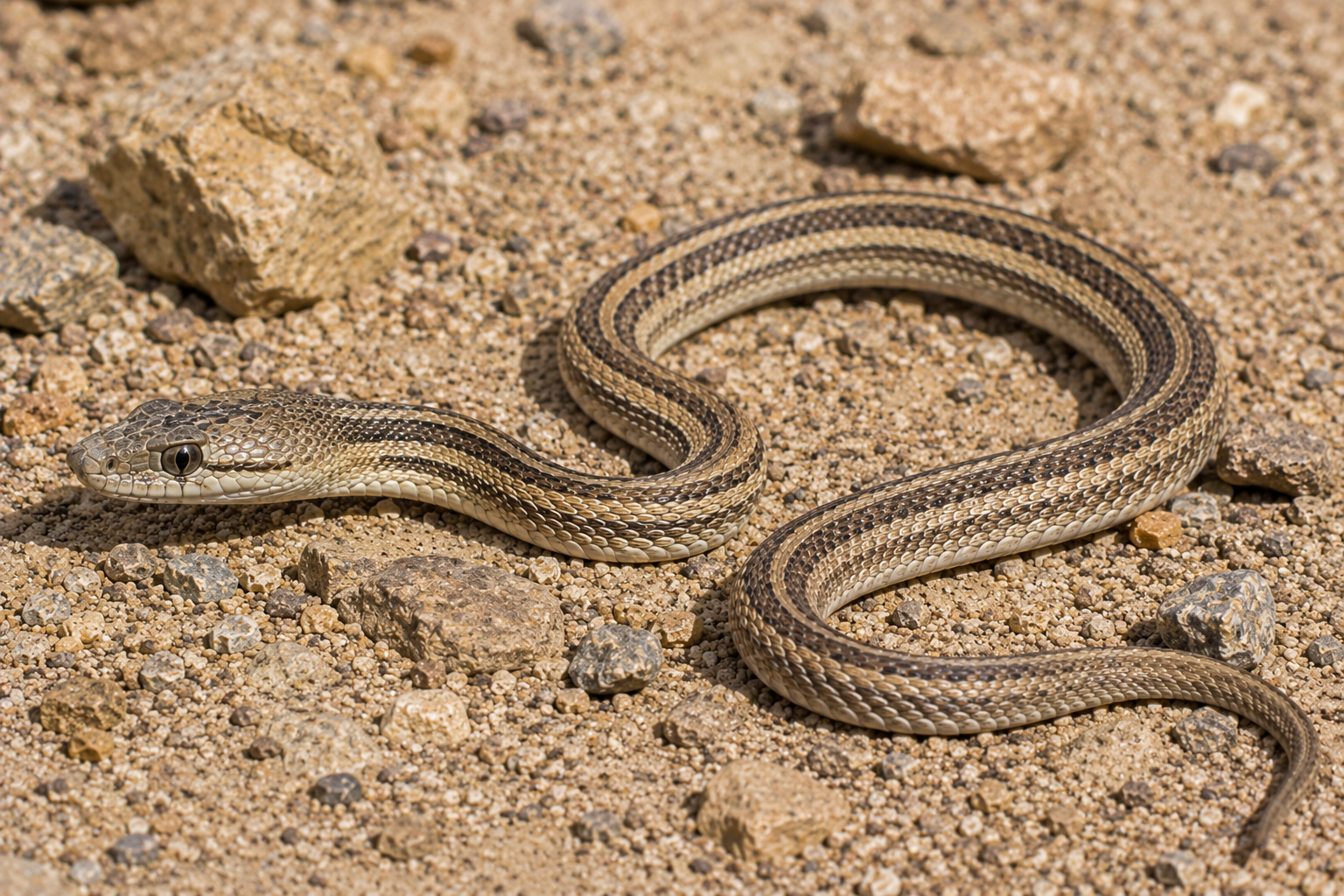
Western Patchnose Snake (Salvadora hexalepis)
The Western Patchnose Snake is a harmless, slender, and exceptionally fast-moving colubrid native to the deserts, grasslands, and scrublands of the southwestern United States and northwestern Mexico. Well adapted to life in arid environments, this species is an active daytime hunter that relies on speed, excellent eyesight, and a uniquely specialized snout to locate and capture prey.
Identification
The most reliable feature for identifying a Western Patchnose Snake is the enlarged, wedge-shaped scale at the tip of its snout, known as the rostral scale. This scale projects forward beyond the mouth and is free along the edges, giving it the appearance of a small guitar pick. The snake uses this distinctive adaptation to probe through loose soil, sand, vegetation, and rock crevices while searching for food.
Western Patchnose Snakes are typically pale gray, tan, cream, or straw-yellow in coloration. A broad light-colored stripe, usually yellow, beige, or white, runs down the center of the back from the neck toward the tail. This dorsal stripe is bordered on both sides by bold dark brown or black stripes, creating a striking contrast that helps distinguish the species from other desert snakes. The underside is generally pale cream or white and may show subtle pink, peach, or orange tones near the tail.
Size and Weight
Adult Western Patchnose Snakes generally measure between 20 and 46 inches (51–117 cm) in total length, although exceptionally large individuals can reach up to 58 inches (147 cm). Despite their length, they remain very slender and lightweight. Most fully grown adults weigh between 50 and 150 grams, with weight varying according to the snake's length, age, and overall condition.
Diet and Foraging
The Western Patchnose Snake is an opportunistic predator that feeds primarily on lizards, reptile eggs, small mammals, nestling birds, and occasionally smaller snakes. It actively searches for prey rather than waiting in ambush and spends much of its time moving through suitable habitat in search of food.
Its enlarged snout serves as an important feeding adaptation, allowing it to investigate rock crevices, sift through loose sand, and uncover buried reptile eggs that would be difficult for many other snakes to access. Once prey is located, the snake relies on its keen eyesight and impressive speed to pursue and capture it in open terrain.
Defense Mechanisms
When threatened, the Western Patchnose Snake almost always chooses escape over confrontation. As a diurnal species, it is active during daylight hours and can move with remarkable speed, often darting into desert shrubs, rocky cover, or animal burrows to avoid danger.
If escape is not possible, the snake may attempt to intimidate a potential predator by drawing its body into an S-shaped coil and rapidly vibrating its tail. This behavior resembles the defensive display of some venomous snakes and may discourage predators from approaching further.
Although completely non-venomous and harmless to humans, a cornered individual may occasionally deliver a quick defensive bite or scratch. Such behavior is uncommon, however, as the species strongly prefers to flee whenever possible.
Reproduction and Lifespan
Breeding typically occurs during early spring. Females lay a clutch of elongated eggs during late spring or summer, usually depositing them in a protected location where temperature and moisture conditions are suitable for development. A typical clutch contains between 4 and 12 eggs.
After an incubation period of several weeks, hatchlings emerge during mid-to-late summer. Young snakes generally measure between 7 and 10 inches (18–25 cm) in length and are fully independent from birth.
Like many other colubrid snakes, Western Patchnose Snakes are believed to live approximately 15 to 20 years in the wild, although individual lifespans can vary depending on habitat quality, predation, and environmental conditions.