
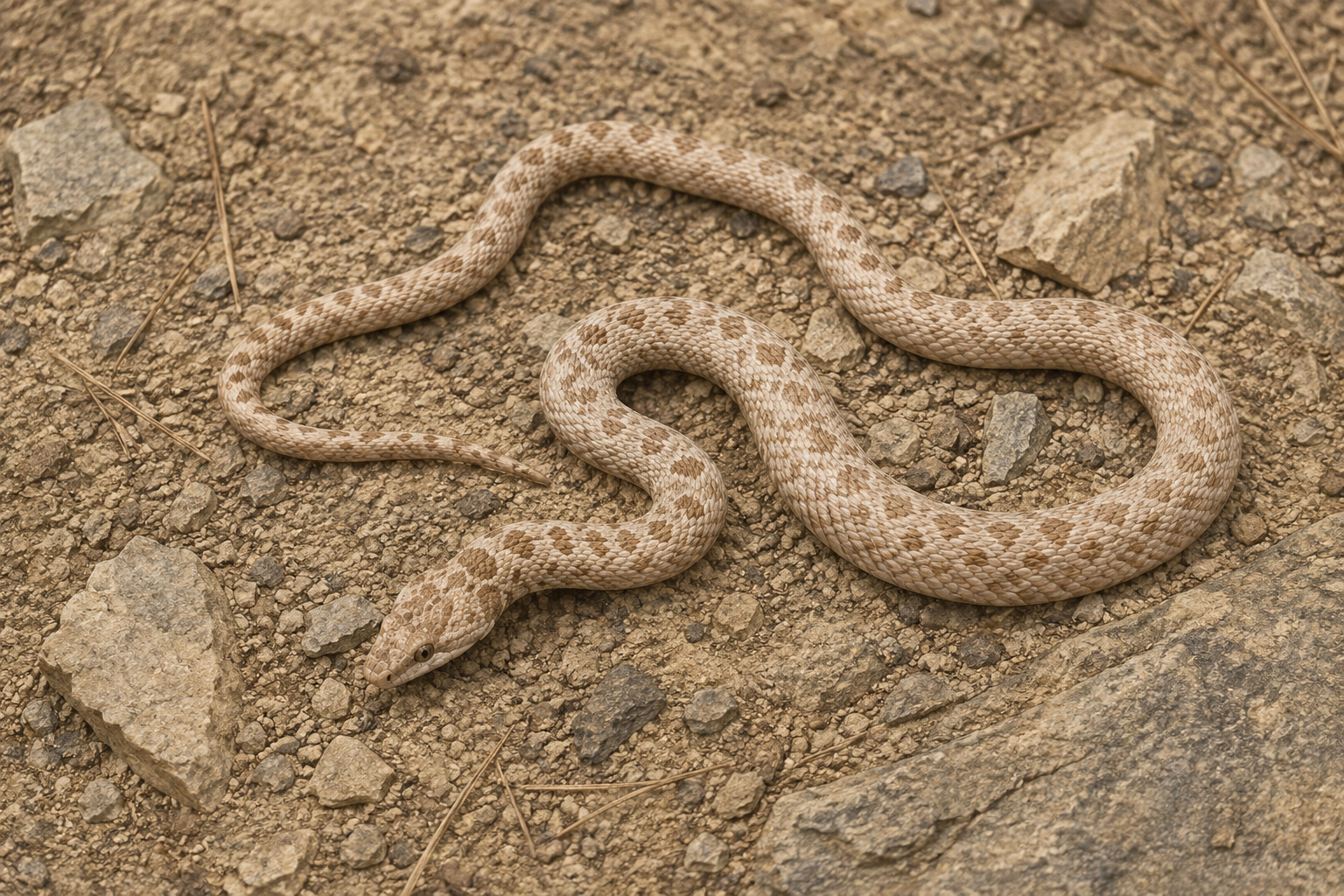
Desert Nightsnake (Hypsiglena chlorophaea)
The Desert Nightsnake is a small, secretive, and harmless nocturnal snake native to Arizona. Considered a habitat generalist, it occupies a wide variety of environments and is frequently encountered crossing roads at night, moving through suburban neighborhoods, or sheltering beneath rocks, logs, and other surface debris in rocky terrain. Because of its nocturnal habits and excellent camouflage, it often goes unnoticed by people.
How to Identify Them in the Wild
Desert Nightsnakes are relatively small snakes, with adults typically measuring between 12 and 26 inches (30–66 cm) in total length. Their base coloration ranges from pale gray and beige to light tan, helping them blend into desert and rocky landscapes. Across the back and sides are darker brown or gray-black blotches that create a distinctive patterned appearance.
One of the most recognizable features of this species is the presence of three dark blotches immediately behind the head, which may sometimes appear as a fused collar. Additional dark markings extend from the eyes toward the corners of the jaw. The underside is usually smooth and unmarked, ranging from pearly white to an iridescent yellowish-white.
The head is noticeably flattened and somewhat triangular in shape, with large copper- to bronze-colored eyes. Unlike most harmless snakes, the Desert Nightsnake has vertically elliptical pupils that resemble those of a cat, an adaptation associated with its nocturnal lifestyle.
Common Misidentifications
Due to their coloration, body shape, and defensive displays, Desert Nightsnakes are commonly mistaken for juvenile rattlesnakes. The easiest way to distinguish them is by examining the tail. A Desert Nightsnake's tail gradually tapers to a fine point and lacks both the rattle and the button found on rattlesnakes. Their small size and blotched pattern can make them appear intimidating, but they are not dangerous to people.
Defensive Behaviors
When threatened, the Desert Nightsnake often relies on a form of defensive mimicry known as viper mimicry. To discourage potential predators, it may coil its body tightly, flatten its head into a broader triangular shape, and thrust its coils forward in a manner that resembles a defensive rattlesnake. It will also rapidly vibrate its tail against leaves, rocks, or other surfaces to imitate the sound and appearance of a rattlesnake preparing to strike.
Although Desert Nightsnakes possess enlarged rear fangs and produce a mild venom used to subdue small prey, this venom is specialized for hunting and poses no significant danger to humans. Bites are uncommon, and the species is considered harmless and non-lethal to people.
Diet
Desert Nightsnakes are primarily nocturnal ambush predators, becoming most active at night and during the low-light periods of dawn and dusk. They typically wait in concealment before quickly capturing passing prey.
Their diet consists mainly of small lizards and lizard eggs, which make up a large portion of their food intake. They also consume frogs, toads, salamanders, and small snakes, including young rattlesnakes. Younger and smaller individuals frequently feed on insects and other small invertebrates before transitioning to larger vertebrate prey as they mature.
Reproduction
Breeding generally occurs during the spring. Desert Nightsnakes are oviparous, meaning females reproduce by laying eggs rather than giving birth to live young. Eggs are typically deposited in moist, protected locations such as rock crevices, beneath surface debris, or inside abandoned mammal burrows where temperature and humidity remain relatively stable.
Females usually lay between 2 and 9 eggs, with Arizona populations averaging approximately 3 to 4 eggs per clutch. After an incubation period of roughly 7 to 8 weeks, the eggs hatch and produce fully independent young snakes. Hatchlings generally measure about 7 inches (18 cm) in length and begin hunting shortly after emerging.
Lifespan and Weight
In the wild, Desert Nightsnakes typically live around 4 to 5 years, although individuals kept in captivity may survive somewhat longer under favorable conditions.
They are extremely slender and lightweight snakes. Adult weights generally range from approximately 2 to 55 grams (0.07–1.9 ounces), with females often growing slightly larger and heavier than males. Despite their delicate build, they are efficient predators well adapted to life in Arizona's deserts, grasslands, and rocky habitats.