
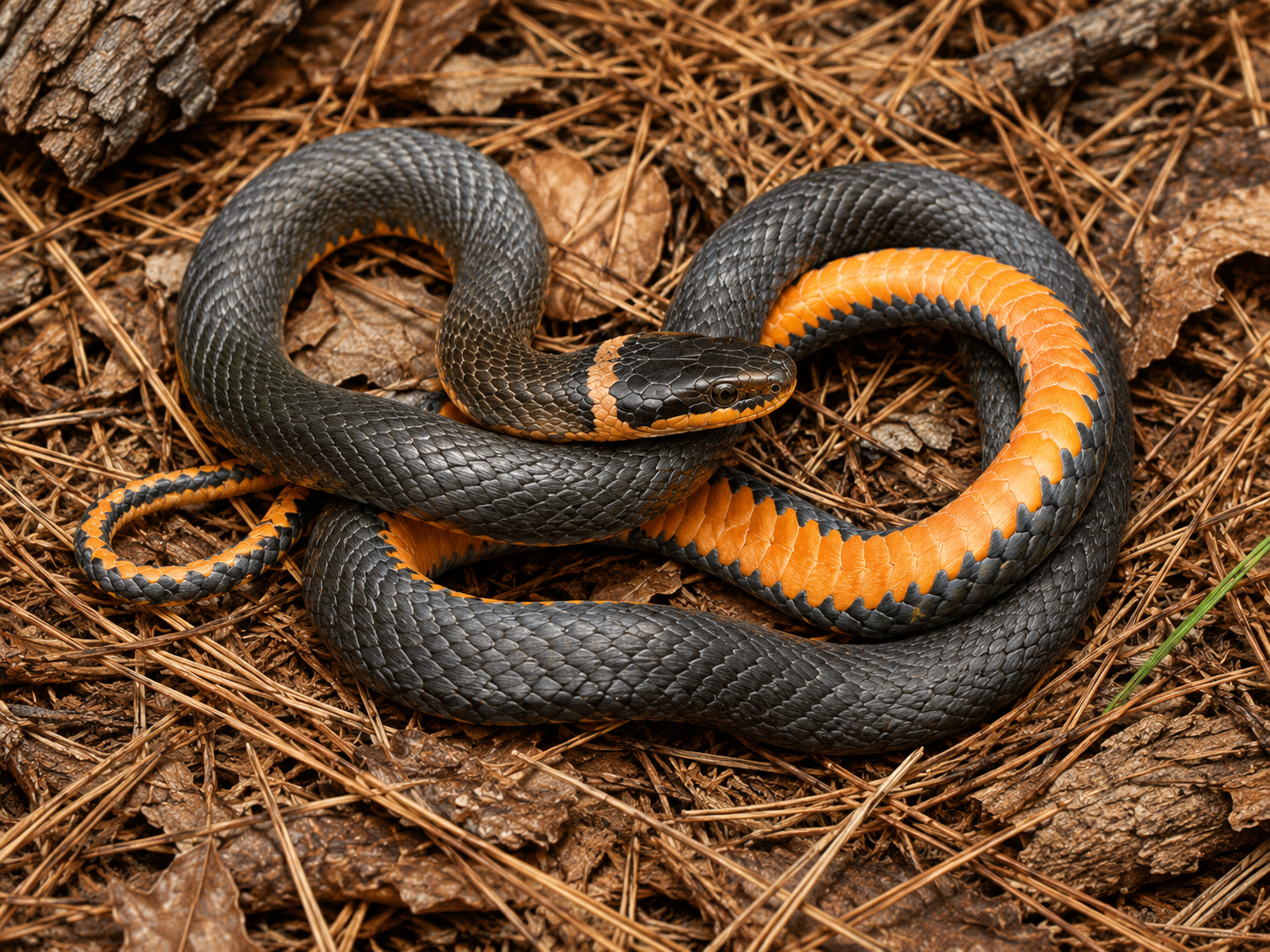
Ring-necked Snake (Diadophis punctatus)
The Ring-necked Snake is a secretive, small-to-medium-sized member of the colubrid family that occurs throughout much of central and southeastern Arizona. Although it possesses a mild venom used for capturing prey, it is considered harmless to humans. These snakes are primarily active at night and spend much of their lives concealed beneath rocks, fallen logs, leaf litter, and other ground cover, making them far less frequently encountered than many other Arizona snake species.
Identification
Ring-necked Snakes are easily recognized by their distinctive coloration. The upper body is typically slate-gray, bluish-gray, or light gray, while the underside is much brighter, ranging from yellow-orange to vivid reddish-orange. The belly is often marked with small black spots or short dark bars, particularly toward the tail.
The species gets its common name from the pale band that usually encircles the neck. This collar is commonly cream, yellow, or orange in color and can vary in width among individuals. While most Arizona populations display this characteristic neck ring, some snakes found in western and northwestern portions of the state may have a reduced collar or lack it entirely.
Their scales are smooth and glossy, giving the snake a polished appearance. Combined with their slender build and bright underside, this smooth texture makes them relatively easy to distinguish from other small Arizona snakes.
Size and Weight
Arizona is home to the Regal Ring-necked Snake (Diadophis punctatus regalis), the largest recognized subspecies of Ring-necked Snake. Most adults measure between 15 and 18 inches (38–46 cm) in length, although exceptionally large individuals may reach up to 34 inches (86 cm).
Despite their length, these snakes remain remarkably thin and lightweight. Most adults weigh only about 10 to 25 grams, with weight varying according to the snake's size and overall body condition.
Diet
Ring-necked Snakes are opportunistic predators that feed on a variety of small animals, with a preference for elongated prey. Their diet commonly includes earthworms, slugs, insect larvae, small frogs, salamanders, lizards, and other small snakes.
To capture and subdue prey, they rely on enlarged rear teeth located in the upper jaw that help deliver a mild venom. This venom is used in combination with gentle constriction to overpower prey before it is swallowed.
Defensive Behavior
When confronted by a potential predator, Ring-necked Snakes generally rely on defensive displays rather than aggression and rarely attempt to bite.
One of their most recognizable behaviors involves curling or elevating the tail to expose the brightly colored red-orange underside. This display serves as a visual warning intended to startle predators, draw attention away from the head, and create the impression that the snake may be toxic or dangerous.
If the threat persists, the snake may release a strong-smelling musk from glands near the base of the tail. The unpleasant odor can discourage predators from continuing to handle or consume the snake.
Reproduction
Breeding typically takes place during the spring or fall. Females lay clutches of 2 to 10 eggs, often depositing them in communal nesting areas shared by multiple females. Suitable nesting sites include moist, decaying logs, rocky crevices, and loose soil that provides stable humidity and protection.
The eggs hatch in late summer. Newly emerged young are delicate and measure approximately 4 to 5 inches (10–13 cm) in length. Hatchlings receive no parental care and are fully independent from the moment they emerge.
Lifespan
Ring-necked Snakes generally have relatively short lifespans in captivity, where they often live around six years. In natural conditions, however, they can be surprisingly long-lived. Wild individuals are believed to commonly survive between 10 and 20 years when they avoid predators, disease, and other environmental hazards.