
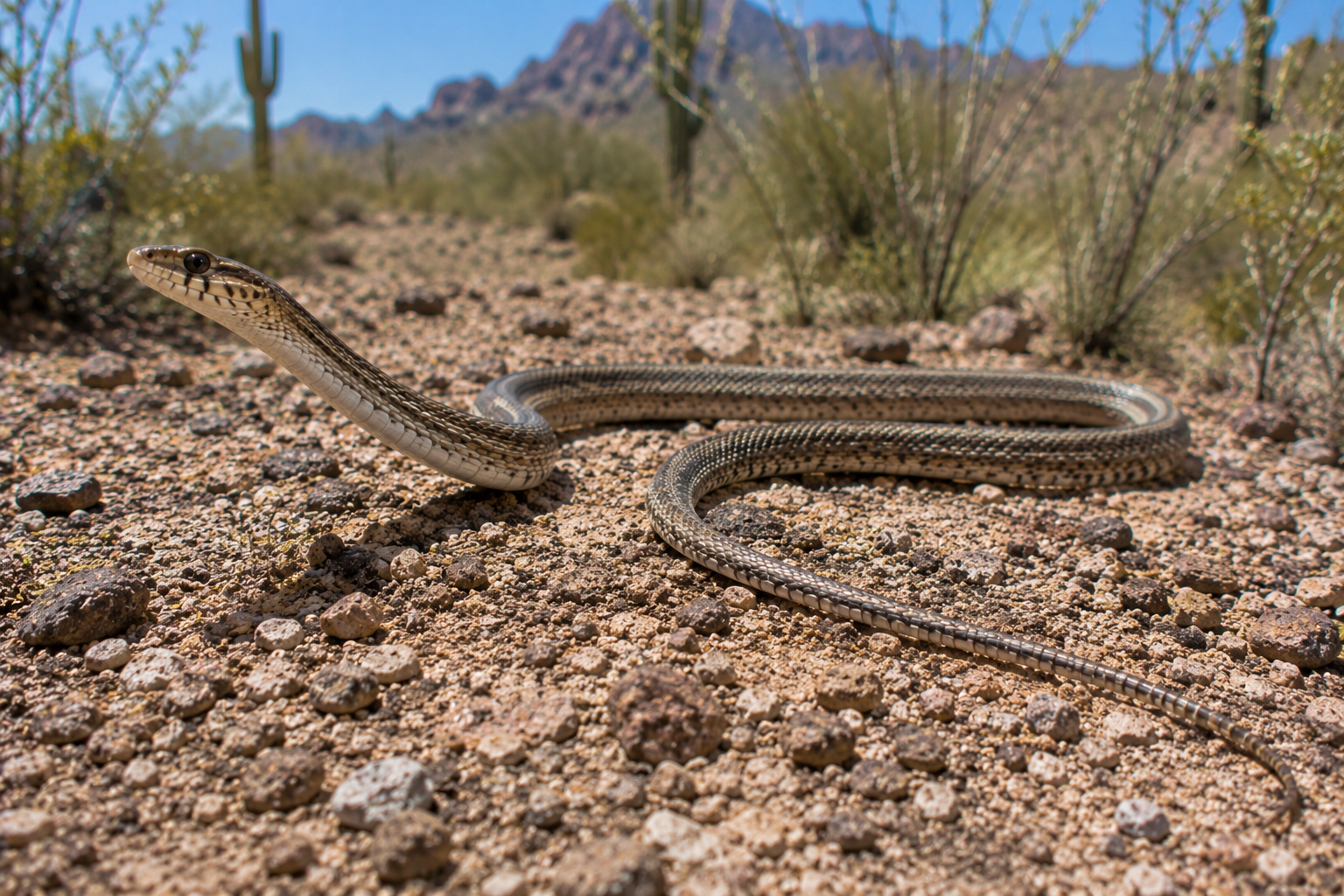
Sonoran Whipsnake (Masticophis bilineatus)
The Sonoran Whipsnake is a fast, highly active, non-venomous snake found in the rugged foothills, canyons, and rocky habitats of southern and central Arizona, New Mexico, and Mexico. It is strictly diurnal, meaning it hunts during the day, and is well known for its speed and striking coloration.
Adults typically measure 2 to 5 feet (60–150 cm) in length, though some individuals may approach 6 feet. Despite their length, they are exceptionally slender and rarely weigh more than a pound. Their coloration begins with a gray-green or bluish-gray head and neck that gradually transitions into a yellow-green body before darkening toward the tail. Two or three pale stripes run along each side of the neck and front half of the body, fading into the background color farther back. They have a broad head, large eyes with round pupils, and smooth scales.
Sonoran Whipsnakes are active hunters that rely on their excellent eyesight to locate prey. Rather than ambushing, they pursue and capture prey using speed and agility. Their diet consists primarily of lizards, but they also consume other snakes—including rattlesnakes—as well as small mammals, frogs, and birds.
When threatened, these snakes usually depend on their remarkable speed to escape, often climbing into trees or dense shrubs. If cornered, they can be defensive and may strike or bite repeatedly. In some cases, they can also shed a portion of their tail when grabbed, allowing them to break free from predators.
Breeding occurs in spring after emerging from winter dormancy. Females typically lay 6 to 13 eggs in early summer, depositing them in protected locations such as burrows or beneath rocks. The eggs hatch after approximately two to three months. While their lifespan in the wild is not well documented, related whipsnake species are known to live between 8 and 20 years.