
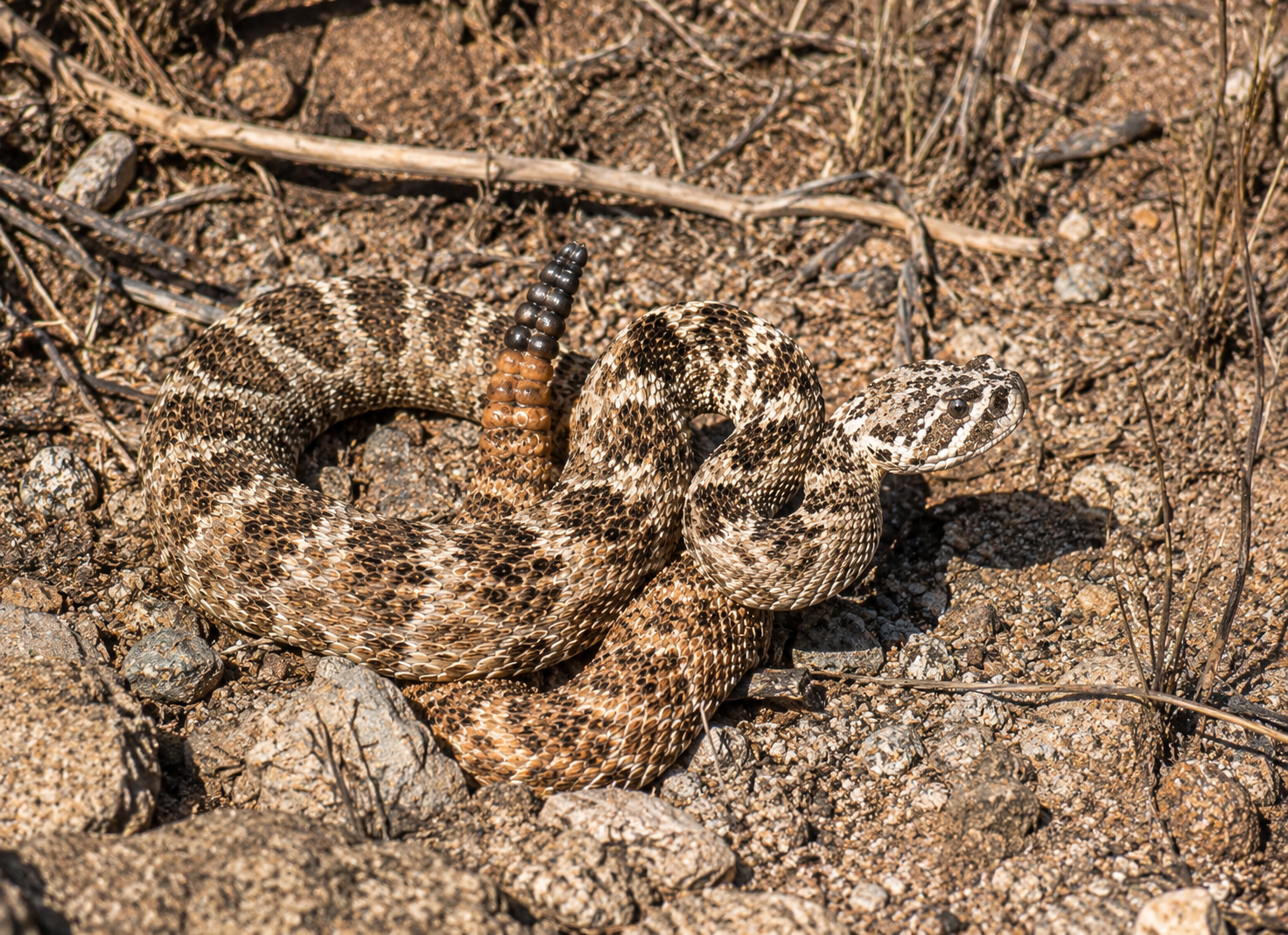
Arizona Tiger Rattlesnake (Crotalus tigris)
Identification: Head and Body Markings
The Arizona Tiger Rattlesnake is one of the most distinctive rattlesnake species found in the Southwest. Its body color can vary considerably, ranging from bluish-gray, olive-gray, and light gray to salmon, pinkish, or orange-brown tones. Across this background are 35 to 52 dark crossbands that wrap around the body and sides, creating the striped appearance that gives the species its common name.
One of the snake's most recognizable features is its unusually small, triangular head, which appears narrow in proportion to the rest of the body and sits atop a noticeably slender neck. A dark stripe is often present along the side of the face, while other facial markings are generally minimal.
The tail typically displays 6 to 10 dark bands near the rattle. Unlike several other rattlesnake species, such as the Mojave Rattlesnake, these bands do not form sharply contrasting black-and-white rings. The rattle itself is relatively large when compared to the snake's overall body size.
Size
Arizona Tiger Rattlesnakes are considered medium-sized pit vipers. Most adults measure approximately 2 feet (60–65 cm) in total length. Larger specimens may reach 35 inches (88–91 cm), with males generally growing slightly larger than females.
Location in Arizona
This species is strongly associated with rocky desert environments and mountainous terrain. It commonly inhabits rugged hillsides, desert washes, alluvial fans, rocky canyons, and steep mountain slopes where crevices provide shelter and hunting opportunities.
Within Arizona, Tiger Rattlesnakes are found primarily throughout central and southern portions of the state. They are frequently encountered in mountain ranges surrounding Tucson, including the Catalina and Rincon Mountains, and can also be found in desert preserves and mountainous areas around the greater Phoenix region.
Eating Habits
Tiger Rattlesnakes are carnivorous predators whose diet consists mainly of lizards and small mammals. Juveniles feed heavily on lizards, particularly whiptails and spiny lizards, while adults tend to consume a greater proportion of rodents such as mice and packrats.
These snakes are primarily nocturnal hunters, becoming most active after sunset during warm weather. Although they often use ambush tactics, they may also actively search for prey among rock piles, crevices, and desert washes. Their unusually small heads allow them to reach deep into narrow cracks and rocky shelters where lizards and rodents often hide.
Strike Distance
Like other rattlesnakes, the Arizona Tiger Rattlesnake does not jump or lunge through the air. Instead, it strikes by rapidly extending its neck and upper body from a coiled position. Most strikes can reach approximately one-third to one-half of the snake's total body length. For an average 2-foot individual, this equates to a strike range of roughly 8 to 12 inches.
For safety, observers should always maintain a distance of at least one full body length from any rattlesnake and avoid attempting to approach or handle the animal.
Venom Toxicity
The venom of the Arizona Tiger Rattlesnake is considered among the most potent of any snake native to the Americas. Based on LD50 toxicity measurements, it is frequently ranked as one of the most toxic rattlesnake venoms and among the most toxic venoms in the Western Hemisphere.
Its venom contains a complex combination of neurotoxins and myotoxins. The neurotoxic components can interfere with normal nerve function, while the myotoxins can cause significant muscle damage and tissue destruction around the bite site.
Despite the extreme potency of its venom, this species typically injects a smaller volume of venom than larger rattlesnakes such as the Western Diamondback. Nevertheless, any bite from an Arizona Tiger Rattlesnake should be considered a serious and potentially life-threatening medical emergency.
What to Do If Bitten
If bitten by an Arizona Tiger Rattlesnake, seek emergency medical care immediately. Calling 911 or contacting emergency services as quickly as possible is critical, even if symptoms have not yet developed.
Remove rings, watches, bracelets, or tight-fitting clothing near the affected area, as significant swelling may occur. Keep the bitten limb as still as possible and position it at or slightly below heart level while waiting for medical assistance. Limiting movement can help slow the spread of venom through the body.
Do not use outdated snakebite treatments. Tourniquets, suction devices, cutting the wound, or applying ice are not recommended and may worsen tissue damage or increase complications. Prompt professional medical treatment remains the safest and most effective response to any rattlesnake bite.