
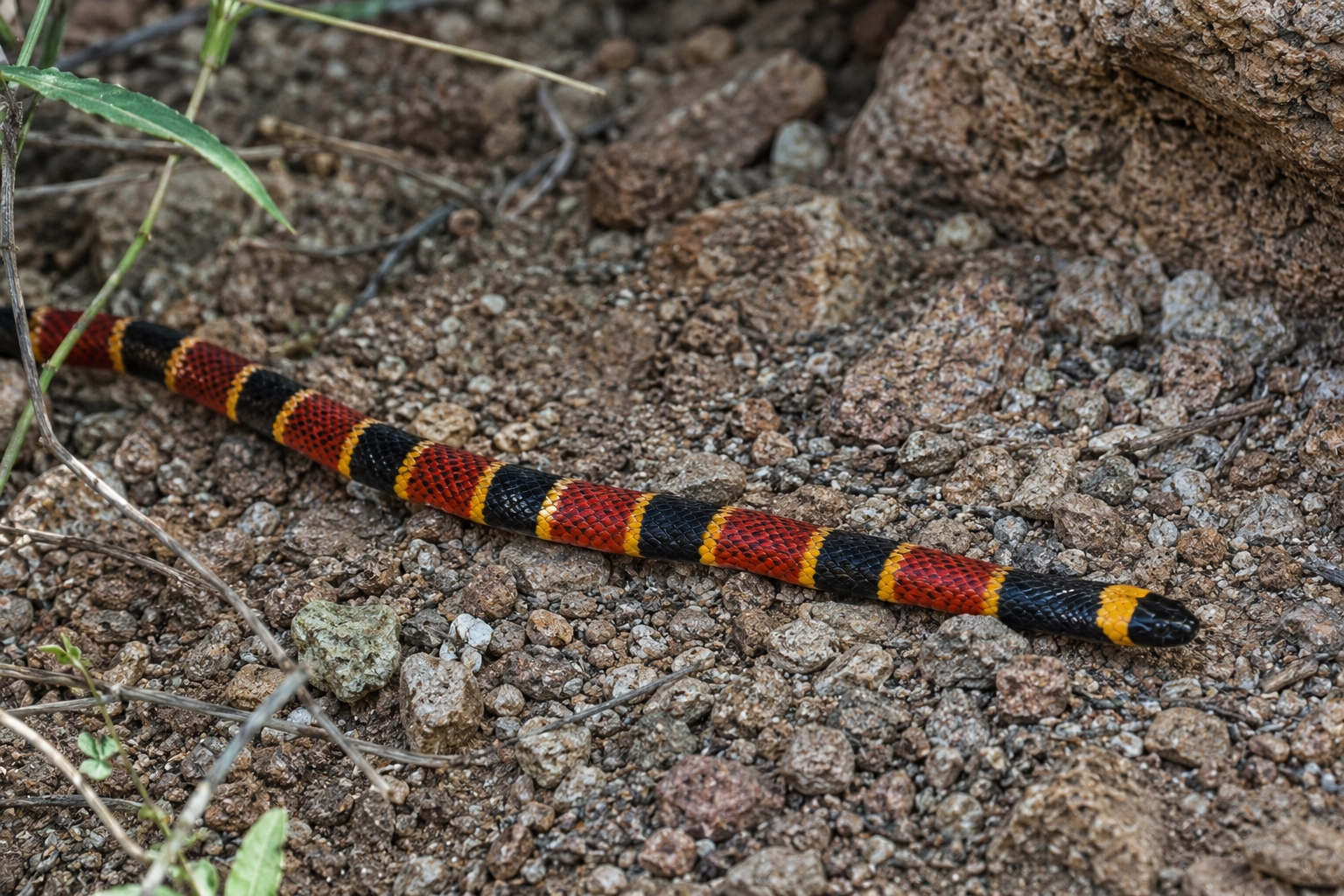
Western Coral Snake (Micruroides euryxanthus)
The Western Coral Snake, sometimes referred to as the Arizona or Sonoran coral snake, is a secretive, burrowing species native to the southwestern United States and northwestern Mexico. It is a close relative of cobras and other elapid snakes and possesses highly potent neurotoxic venom. Despite this, it is extremely shy, non-aggressive, and spends most of its life hidden underground or beneath debris. Human encounters are rare, and there are no recorded fatalities attributed to this species.
Identifying Markings (Head and Body)
Correct identification of the Western Coral Snake (Micruroides euryxanthus) is based on its distinctive coloration and body pattern. The head is short and blunt, blending smoothly into the neck, and is typically marked with a solid black cap that extends just behind the eyes.
The body is characterized by complete encircling bands of red, black, and pale yellow or white. These bands wrap entirely around the body rather than breaking along the sides. In Arizona populations, the most reliable field identifier is the arrangement of the banding pattern, where red bands are consistently bordered by yellow or white bands.
Although several harmless species, including kingsnakes, may display similar coloration, their band arrangements differ from those of the coral snake. Because natural variation and mimic species exist, it is strongly advised not to handle any banded snake encountered in the wild.
Length and Movement Characteristics
Western Coral Snakes are small and slender, with adults typically measuring between 13 and 22 inches in length. Their bodies are thin and delicate, often no thicker than a standard pencil.
Despite common myths, they are not capable of leaping or lunging. Like all North American snakes, their strike range is extremely limited, usually only a few inches. A bite typically requires very close proximity or direct contact, such as when a snake is accidentally handled or stepped on.
Eating Habits
Western Coral Snakes are highly specialized predators with a diet focused primarily on other small reptiles. Their main prey includes blind snakes, small black-headed snakes, and various small lizards.
They are largely fossorial, spending approximately 90% of their time underground or concealed beneath rocks and leaf litter. Using their sense of smell, they actively track prey into narrow burrows and crevices. Once located, prey is subdued with venom before being consumed.
Location in Arizona
In Arizona, Western Coral Snakes are found primarily in the central and southern regions of the state, with their range extending into northwestern Mexico.
They prefer arid to semi-arid environments, including rocky bajadas, desert scrublands, and foothills reaching elevations of approximately 5,800 feet. Because of their secretive nature, they are rarely seen, but are most likely to appear above ground at night or following warm seasonal summer rains.
Venom Potency
The venom of the Western Coral Snake is highly potent on a drop-for-drop basis and contains powerful neurotoxins that rapidly affect the nervous system of its prey. However, despite its potency, the species is considered medically low risk to humans.
This is due to several factors: their small mouth, short fixed front fangs, and the relatively small quantity of venom they produce. Envenomation typically requires the snake to maintain a bite and chew for several seconds. There are no confirmed recorded human fatalities from the Arizona coral snake.
What to Do If Bitten
Bites from Western Coral Snakes are extremely uncommon and usually occur only when the animal is accidentally stepped on or handled. If a bite does occur, it should be treated as a medical emergency.
The individual should carefully move away from the snake if it is still attached and maintain a safe distance. The affected limb should be kept still and positioned at or below heart level to help slow venom circulation. Tourniquets should not be applied, and attempts to remove venom by suction should be avoided, as these methods can cause additional harm.
Immediate medical attention is essential. Call 911 or proceed to the nearest emergency facility as quickly as possible. Symptoms such as drooping eyelids, difficulty swallowing, or slurred speech may be delayed for 1 to 12 hours, making prompt medical observation critical even if no immediate symptoms are present.