
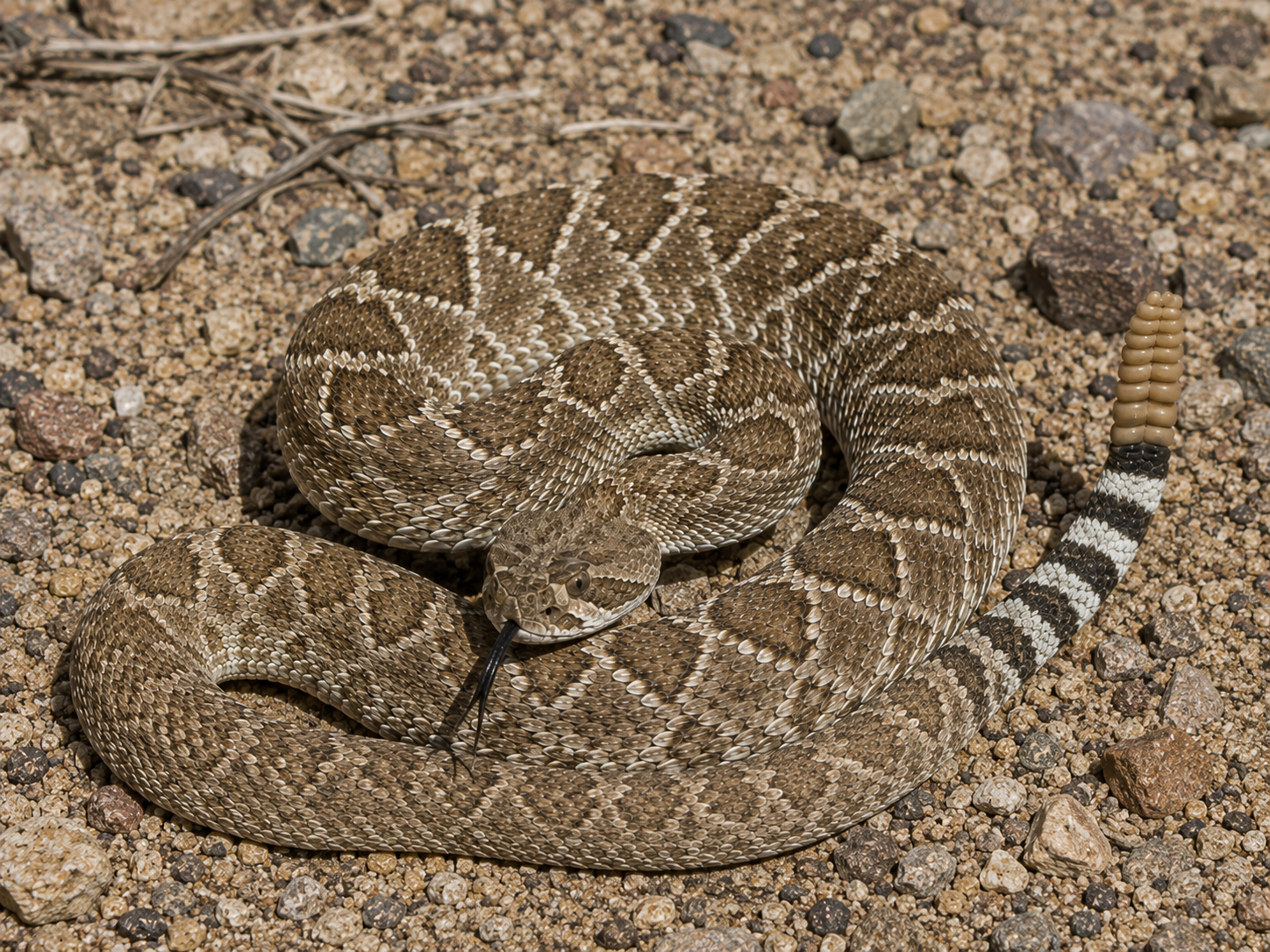
Western Diamondback Rattlesnake (Crotalus atrox)
Identification & Markings
The Western Diamondback Rattlesnake is one of the most recognizable venomous snakes in the American Southwest. This heavy-bodied pit viper can be identified by its broad, triangular head, which is noticeably wider than its narrow neck. A pair of dark facial stripes extends diagonally from each eye toward the corners of the jaw, creating a distinctive facial pattern.
Body coloration varies from gray and tan to brown or pinkish hues, allowing the snake to blend effectively into desert and rocky environments. Along the back is a series of dark, diamond-shaped markings outlined by lighter scales, usually numbering between 23 and 45. Near the end of the tail, a sequence of alternating black and pale gray or white bands appears just before the rattle, forming one of the species' most recognizable field marks.
Size
Adult Western Diamondback Rattlesnakes commonly reach lengths of 4 to 6 feet (1.2 to 1.8 m). Large individuals may exceed this range, with exceptional specimens approaching 7 feet (2.1 m), making this species one of the largest rattlesnakes found in North America.
Eating Habits
Western Diamondbacks are primarily ambush predators that rely on camouflage and patience rather than actively pursuing prey. They possess specialized heat-sensing pits located between the eyes and nostrils, allowing them to detect warm-blooded animals even in complete darkness.
Their diet consists mainly of small mammals, including rabbits, mice, rats, gophers, and other rodents. They will also consume birds, lizards, and occasionally other small vertebrates. Once prey comes within range, the snake delivers a rapid strike, injecting venom that quickly incapacitates the animal before tracking and swallowing it whole.
Location in Arizona
This species is highly adaptable and occupies a wide variety of habitats throughout Arizona. Western Diamondbacks are commonly encountered in desert basins, rocky foothills, grasslands, river corridors, and scrub-covered hillsides. They are also frequently found near the outskirts of residential developments and urban areas where suitable habitat remains. The species occurs across much of the state at low to mid elevations.
Strike Distance
Like other rattlesnakes, the Western Diamondback can strike surprisingly quickly. An individual is generally capable of striking a distance equal to approximately one-third to one-half of its body length. For a snake measuring 4 feet long, this can result in a strike range approaching 2 feet. Although they cannot jump, they can elevate the front portion of their body into a defensive S-shaped posture before striking.
Venom Toxicity
The venom of the Western Diamondback is primarily hemotoxic and cytotoxic. Its effects include damage to blood cells, disruption of normal blood clotting processes, and significant injury to surrounding tissues. Bites often result in severe pain, swelling, bruising, and tissue destruction around the bite site.
Without prompt medical treatment, serious complications can occur, including permanent tissue damage, loss of function, or, in severe cases, amputation. Modern antivenom treatments, including CroFab and related therapies, have greatly improved outcomes, and fatalities are now uncommon when professional medical care is received quickly.
What to Do If Bitten
A bite from a Western Diamondback Rattlesnake should always be treated as a medical emergency. If a bite occurs, move away from the snake immediately to prevent additional strikes and call emergency medical services as soon as possible.
The affected limb should be kept as still as possible and positioned at or slightly below heart level to help slow venom circulation. Any jewelry, watches, rings, or tight-fitting clothing near the bite area should be removed before swelling develops.
Outdated first-aid methods should be avoided. Do not apply a tourniquet, attempt to cut the wound, use suction devices, or place ice on the bite. These techniques have not been shown to remove venom effectively and may increase tissue damage or worsen the injury. The most effective treatment is rapid transportation to a medical facility where antivenom and supportive care can be provided.