
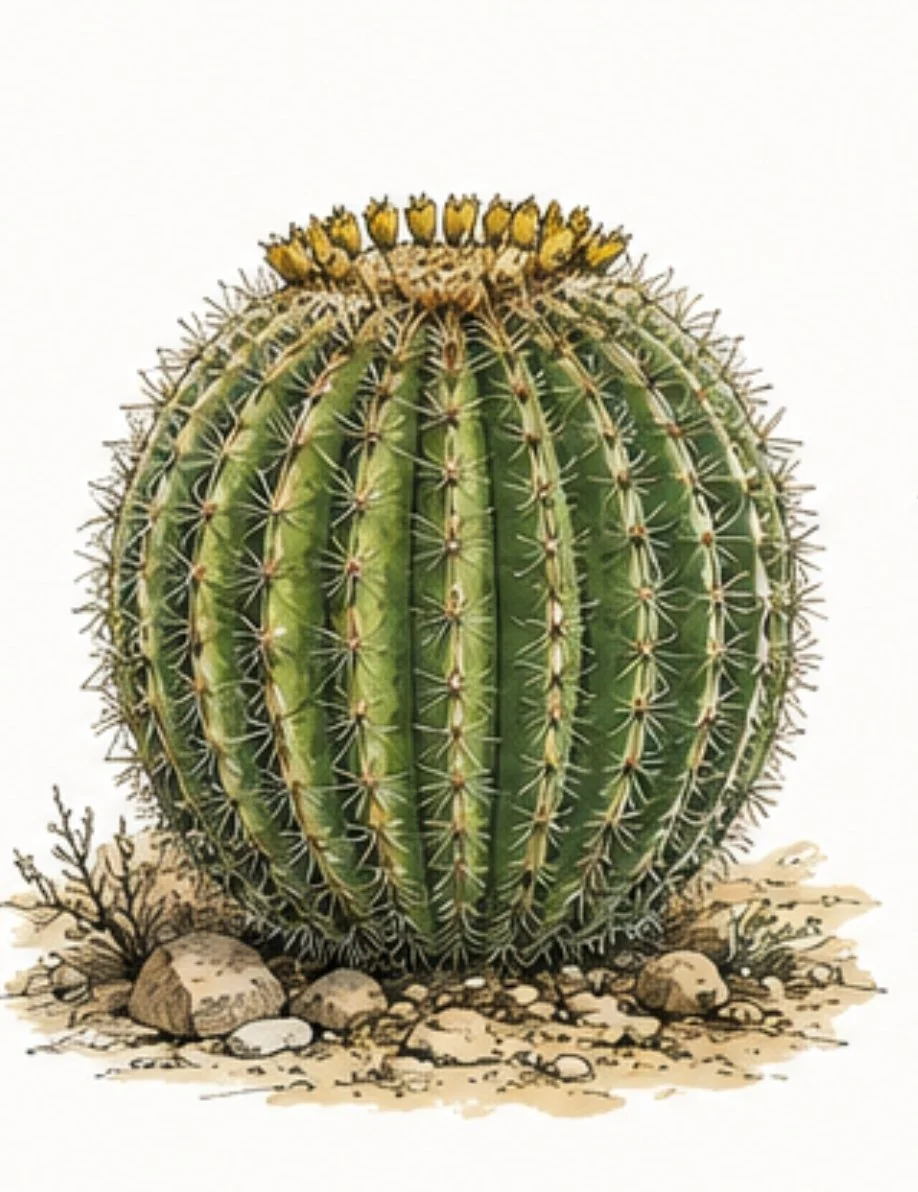
Arizona Barrel Cactus (Ferocactus wislizeni)
The Arizona barrel cactus, commonly known as the fishhook barrel cactus, is a slow-growing desert plant recognized for its thick, ribbed body and impressive hooked spines. Native to the deserts of the American Southwest, this species is especially notable for its bright yellow to orange flowers and its characteristic tendency to lean toward the south as it ages.
Where It's Found
Arizona barrel cacti are widely distributed throughout the Sonoran and Chihuahuan Deserts of the southwestern United States and northern Mexico. In Arizona, they are especially common in the state's southern desert regions, including areas around Apache Junction. Their range extends eastward into New Mexico and Texas and southward into Mexico.
These cacti are most often found on rocky hillsides, gravel-covered bajadas, desert washes, and other well-drained desert landscapes. They typically occur at elevations between 1,000 and 5,600 feet, where they are adapted to intense heat, seasonal rainfall, and prolonged drought.
How Long It Takes to Grow
The Arizona barrel cactus is considered one of the slower-growing cactus species. Under natural conditions, it generally increases in size by only about 1 to 3 inches per year.
Reaching maturity is a lengthy process, often requiring approximately 30 years. At this stage, the cactus commonly develops a diameter of around 3 to 3.5 feet and displays its characteristic deep ribs. Wild specimens frequently live between 50 and 100 years, while exceptionally old individuals may survive for as long as 130 years.
Root System
Rather than producing a deep taproot, the Arizona barrel cactus develops an extensive network of shallow roots that spread outward just beneath the soil surface. This broad root system allows the plant to quickly capture and absorb water from brief but intense desert rainstorms, particularly during the summer monsoon season.
Its Defense System
One of the cactus's most recognizable features is its dense covering of spines. These spines emerge from raised areoles along the vertical ribs and serve as an effective defense against animals that might attempt to feed on the plant. The central spines are especially distinctive, curving outward in a hook-like shape that gives rise to the common name "fishhook barrel cactus."
In addition to providing protection, the spines help shade the cactus's outer surface. This natural shading reduces direct sun exposure and helps limit moisture loss through evaporation, an important adaptation for survival in arid environments.
"Arms" or Limbs (Branching)
Unlike the iconic saguaro cactus, the Arizona barrel cactus normally grows as a single, unbranched column. Most specimens retain this solitary form throughout their lives and do not develop arms or side branches.
In rare cases, branching may occur if the plant's growing tip is severely damaged by events such as frost injury, fungal infection, lightning strikes, or other forms of physical trauma. When this happens, the cactus may produce multiple growth points as a survival response.
Because of this, people sometimes confuse barrel cacti with young saguaros. However, saguaros are known for eventually producing arms, typically not until they are approximately 50 to 75 years old.
How Big Do They Get?
Most Arizona barrel cacti found in the wild reach heights of approximately 3 to 6 feet. Exceptionally old or cultivated specimens may occasionally grow between 6 and 10 feet tall under favorable conditions.
At maturity, these cacti commonly measure between 18 and 30 inches in diameter, giving them the stout, barrel-shaped appearance for which they are named.