
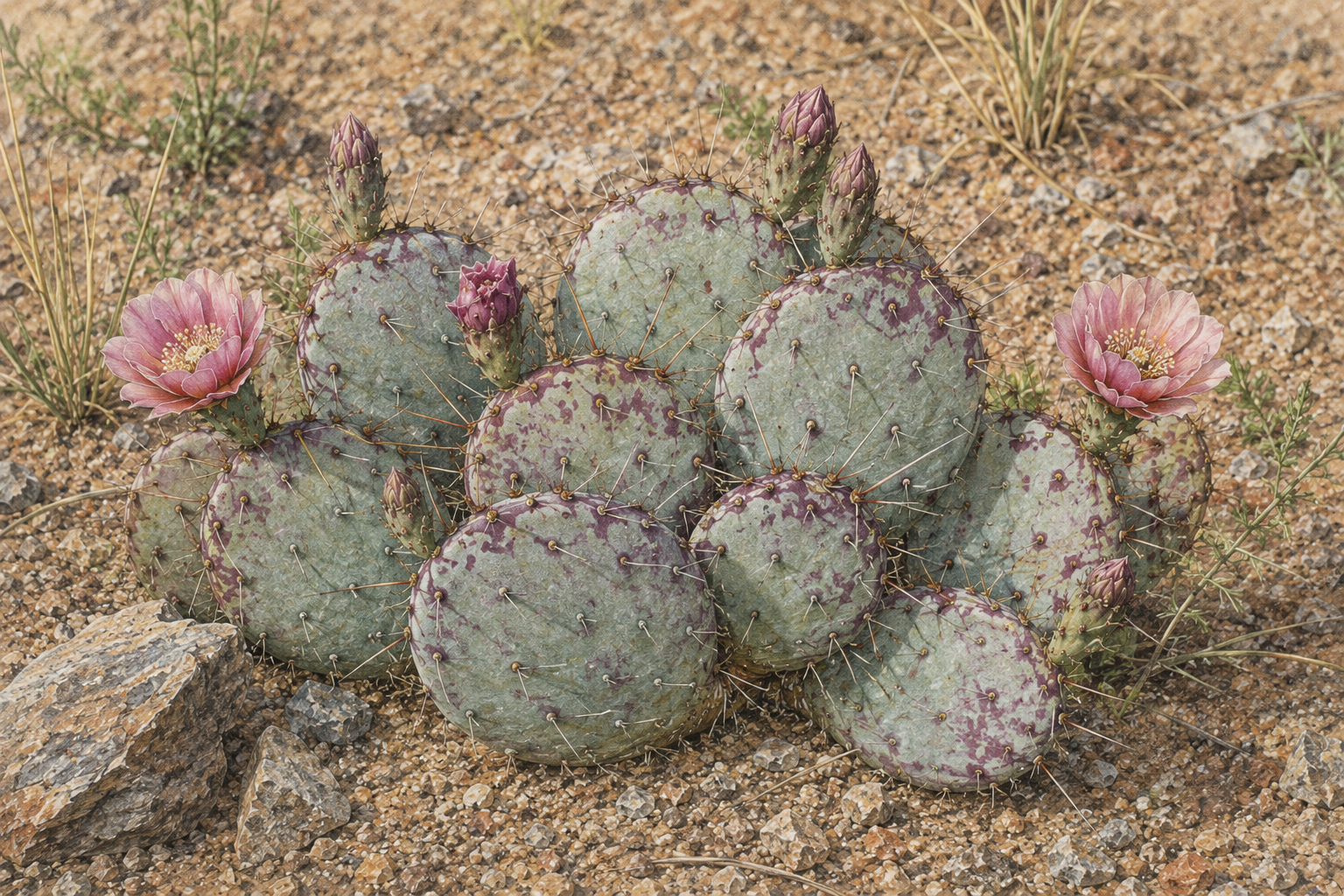
Pancake Prickly Pear (Opuntia chlorotica)
Overview
The Pancake Prickly Pear is a distinctive cactus species recognized for its rounded, bluish-green pads that often resemble a stack of pancakes. Unlike many low-growing prickly pear species, it gradually develops a sturdy woody trunk and an upright growth form, giving mature specimens the appearance of a small desert tree. Its unique appearance, drought tolerance, and adaptability make it one of the most recognizable cacti of the American Southwest.
Distribution and Habitat
The Pancake Prickly Pear is native to the arid regions of the southwestern United States and northern Mexico. Within the United States, it occurs naturally in Arizona, California, Nevada, New Mexico, and Utah. It is most commonly found on rocky slopes, canyon walls, mesas, and desert hillsides where drainage is excellent and sunlight is abundant.
This species typically grows at elevations ranging from approximately 2,000 to 6,000 feet, thriving in environments where rainfall is limited and temperatures can fluctuate dramatically throughout the year.
Growth Rate
Growth is relatively slow, especially when plants are started from seed. Seed-grown specimens often require three to four years to reach maturity and may need several additional years before producing flowers and fruit.
Plants propagated from individual pads establish more quickly. Under favorable conditions, a detached pad can develop roots within about a month when planted in well-drained soil. Once established, the cactus commonly produces between two and five new pads annually, although growth rates can vary depending on rainfall, temperature, soil quality, and sun exposure.
Root System
The Pancake Prickly Pear possesses a root system designed to maximize water collection in dry environments. Most of its roots spread outward near the soil surface, allowing the plant to rapidly absorb moisture from brief desert rainstorms before it evaporates.
In addition to these shallow roots, the cactus develops a deeper anchoring root that helps stabilize the plant and access moisture stored farther below the surface during extended periods of drought. Together, these root structures enable the species to survive in some of the harshest desert conditions.
Defense Mechanisms
Like many cacti, the Pancake Prickly Pear relies on physical defenses to discourage animals from feeding on its pads. The plant produces stout spines that are typically golden yellow when young and often darken to reddish-brown or black as they age. These spines commonly measure between one and two inches in length and provide effective protection against browsing wildlife.
The cactus also produces glochids, which are tiny barbed bristles clustered within the areoles. These microscopic structures detach easily upon contact and can become embedded in skin, causing irritation and discomfort. Because glochids are difficult to remove, they serve as an effective secondary defense against potential predators.
Pad and Branch Development
New growth occurs through the production of additional pads that emerge from existing pads. As the plant matures, these pads form branching structures that gradually increase the cactus's overall size and complexity.
A young rooted pad typically begins producing its first new pads within one or two active growing seasons, usually during spring and summer. Environmental factors such as sunlight, soil conditions, and moisture availability influence the speed of development.
Unlike many prickly pear species that remain close to the ground, the Pancake Prickly Pear eventually develops a thick central trunk. This trunk supports elevated branches and contributes to the plant's characteristic tree-like appearance as it ages.
Size
Mature Pancake Prickly Pears generally grow as upright shrubs or small tree-like cacti. Most specimens reach heights between 3 and 8 feet, although exceptionally large individuals may approach 10 feet under ideal conditions.
The plant often develops a broad, spreading canopy and can reach widths of approximately 3 to 7 feet. Individual pads are usually circular to oval in shape and commonly measure between 4 and 8 inches across, creating the layered appearance for which the species is named