
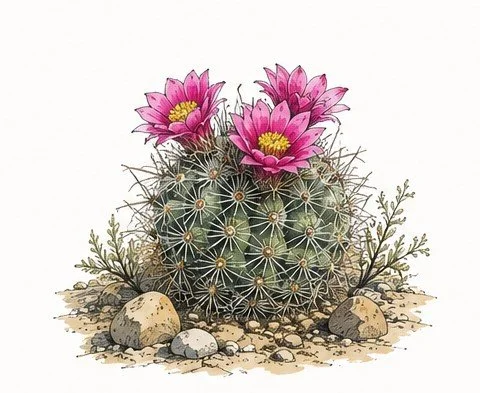
Arizona Hedgehog Cactus (Echinocereus arizonicus)
Where It's Found
The Arizona hedgehog cactus is a rare and federally endangered cactus known for its vibrant crimson flowers and dense, clumping growth form. Its natural distribution is extremely limited, making it one of Arizona's most localized cactus species.
This cactus is found almost exclusively in central Arizona, particularly in the vicinity of Globe and Miami within Gila and Pinal counties. Many populations occur within the boundaries of the Tonto National Forest. It typically grows on steep, rocky terrain, including cliff faces, boulder fields, crevices, and exposed slopes that face either north or south. Most plants occur at elevations ranging from approximately 3,400 to 5,300 feet (1,035–1,615 meters).
Size
Unlike Arizona's towering cactus species, the Arizona hedgehog cactus remains relatively compact throughout its life.
Individual stems are cylindrical in shape and generally reach heights of 8 to 16 inches (20–40 cm), with diameters ranging from about 3 to 10 inches (8–25 cm). As the plant matures, it develops multiple stems that grow together in dense clusters. These clumps can gradually expand over time, with mature colonies reaching widths of up to 3 feet (0.9 m).
Root System
The Arizona hedgehog cactus possesses a specialized root system that allows it to survive in harsh, rocky environments where water is scarce and soil is limited.
At the center of the root system is a thickened taproot that helps anchor the plant securely within cliff cracks, rocky slopes, and deep crevices. Extending outward from this central root is a network of shallow, fibrous roots that spread through narrow pockets of soil and rock fissures. These roots are highly efficient at absorbing moisture from rainfall, allowing the cactus to take advantage of brief periods of water availability before it rapidly drains away.
Growth Rate and Stem Development
This species is considered a slow-growing cactus, particularly when developing from seed in its natural habitat.
Seedlings may require 8 to 10 years before reaching reproductive maturity and producing flowers. However, stems propagated through vegetative methods can establish roots much more quickly and may become mature, flowering plants within 1 to 2 years under suitable conditions.
Unlike cacti such as the saguaro, which develop branching arms from a central trunk, the Arizona hedgehog cactus expands by producing new stems from its base. Young plants commonly begin developing additional stems within 3 to 5 years of germination. Mature specimens often contain between 4 and 20 stems, although exceptionally large clumps may support more than 50 individual stems.
Defense
The Arizona hedgehog cactus relies primarily on physical defenses to protect itself from herbivores and environmental stress.
Each stem is densely covered with clusters of sharp radial and central spines. The central spines can reach lengths of nearly 1.9 inches (4.8 cm) and often curve downward. These spines create an effective barrier against animals that might otherwise feed on the cactus. In addition to providing protection, the dense covering of spines helps reduce exposure to intense sunlight by creating partial shade across the stem surface, helping the plant conserve moisture in Arizona's arid climate.