
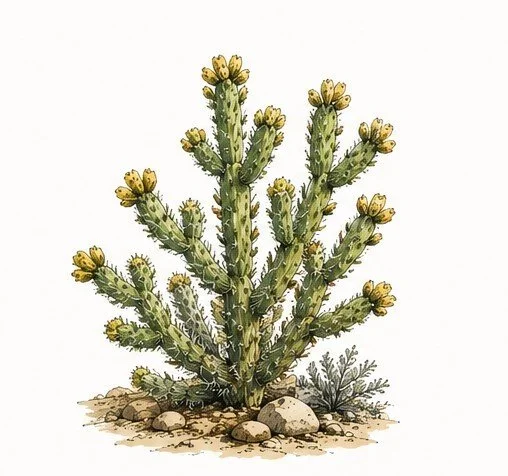
Desert Christmas Cholla (Cylindropuntia leptocaulis)
Overview
The Desert Christmas Cholla is a distinctive cactus native to the deserts of the southwestern United States and northern Mexico. It is best known for the bright red fruits that remain on the plant through the winter months, giving it a festive appearance that inspired its common name. Unlike many upright cactus species, this cholla usually develops as a sprawling, densely branched shrub and is often intertwined with surrounding vegetation rather than growing as a completely isolated plant.
Where It's Found
The Desert Christmas Cholla occurs throughout southern and central Arizona, New Mexico, Texas, Oklahoma, and much of northern Mexico. It is most commonly found at elevations ranging from approximately 1,000 to 5,000 feet. In natural habitats, this species frequently grows beneath the protective cover of larger desert plants known as nurse plants. Mesquite trees, palo verde trees, and creosote bushes commonly provide shade and protection for developing chollas, helping them establish in harsh desert environments.
How Big Do They Get?
Most mature Desert Christmas Chollas reach heights of about 2 to 5 feet, although larger specimens may grow to around 6 feet when standing independently. Plants that receive support from nearby shrubs or trees can climb higher and occasionally exceed 10 feet in total height. The stems are notably slender, with individual segments typically measuring only about one-half inch in diameter, giving the plant a delicate appearance despite its formidable defenses.
Growth Rate & Branching
The Desert Christmas Cholla is generally considered a moderate-growing cactus. Under favorable conditions, it commonly produces between 3 and 12 inches of new growth each year, with rainfall and growing conditions playing a significant role in determining growth rates.
Its segmented stems readily produce new branches, creating the dense, tangled structure characteristic of mature plants. Detached stem segments that successfully root can begin producing secondary branches within their first year. New branches often emerge at sharp angles from existing segments, gradually forming an intricate network of stems as the plant expands.
Root System
Like many desert-adapted cacti, the Desert Christmas Cholla relies on a shallow but extensive root system designed to capture moisture quickly whenever rain occurs. Most roots remain close to the soil surface while spreading outward over a broad area. During seasonal rains, especially summer monsoons, the plant rapidly develops fine root hairs that efficiently absorb available moisture. Water collected by the roots is stored within the succulent stems, allowing the cactus to survive extended dry periods. As drought conditions return, many of these temporary root hairs disappear, reducing water loss while the larger, more permanent roots remain dormant until the next rainfall event.
Defense System
The Desert Christmas Cholla possesses one of the most effective defense strategies among desert plants. Its stems are armed with sharp, barbed spines that can reach lengths of up to 2 inches. These spines easily penetrate skin, fur, and clothing, making contact with the plant particularly unpleasant for animals and people alike.
In addition to its spines, the cactus has segmented stems that detach with remarkable ease. When an animal brushes against the plant, individual stem segments may break away and become attached to fur, feathers, clothing, or footwear. Because these detached segments are capable of rooting and developing into new plants, this adaptation serves both as a defense mechanism and as an effective method of reproduction. By allowing stem segments to be carried to new locations, the Desert Christmas Cholla can spread across suitable habitat without relying solely on seeds.