
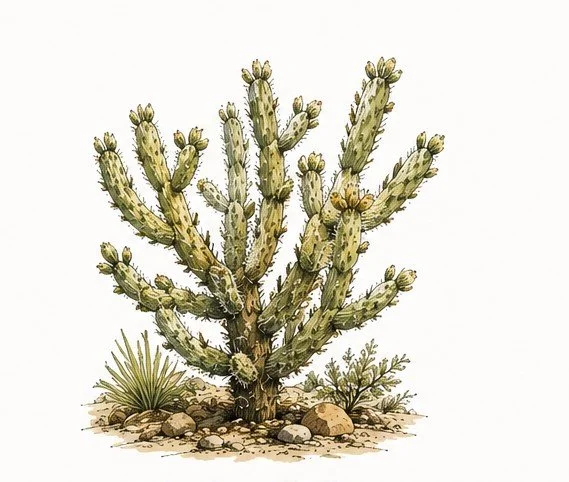
Arizona Staghorn Cholla (Cylindropuntia versicolor)
Where It’s Found
The Arizona Staghorn Cholla is a distinctive desert cactus known for its branching, antler-like growth and its colorful spring blooms. This species is native to the Sonoran Desert and is most commonly found in southeastern Arizona, particularly in and around the Tucson region. It typically grows at elevations ranging from approximately 2,000 to 4,300 feet, where it thrives on rocky hillsides, desert scrublands, open slopes, and along washes that occasionally carry seasonal rainfall.
Size
Mature Arizona Staghorn Chollas generally reach heights of 3 to 6.5 feet, although exceptionally large specimens growing under favorable conditions may exceed 10 feet and occasionally approach 15 feet in height. Rather than forming a compact shape, the plant develops an open, irregular crown composed of numerous branching stems. Older plants can spread outward considerably, sometimes reaching widths of 15 to 16 feet across.
Growth Rate
This species is considered a slow to moderately growing cactus. New stem segments typically extend by about 3 to 5 inches each year, though growth rates vary depending on rainfall, soil conditions, and overall plant health. While seedlings develop slowly, Staghorn Chollas often spread successfully through vegetative reproduction. Detached stem segments can root after falling to the ground, allowing new plants to become established more quickly than those grown from seed.
Branch Development
The Arizona Staghorn Cholla is characterized by its segmented stems and highly branched structure. A newly rooted stem segment may begin producing additional branches within one to three years, depending largely on moisture availability and seasonal growing conditions. As the cactus matures, these branches repeatedly divide and fork, creating the distinctive antler-like appearance that gives the plant its common name. Over time, the branching network becomes increasingly complex and irregular.
Root System
Like many desert cacti, the Arizona Staghorn Cholla possesses a shallow but highly effective root system designed to maximize water absorption. Its roots spread horizontally near the soil surface, allowing the plant to quickly capture moisture from brief desert rainstorms before it evaporates. The root system consists primarily of fine, fibrous roots that can rapidly respond to changing moisture conditions. During extended periods of drought, the plant may shed delicate root hairs as a water-conservation strategy, reducing moisture loss until rainfall returns.
Defense System
The Arizona Staghorn Cholla is among the most heavily defended plants in the Sonoran Desert. Its stems are covered with dense clusters of sharp spines that are enclosed in pale, papery sheaths. Each spine is equipped with microscopic backward-facing barbs that help it lodge firmly into skin, fur, or clothing, making removal difficult.
In addition to its spines, the cactus relies on easily detached stem segments as both a defense and reproductive strategy. The joints connecting the segments are relatively weak, allowing pieces of the plant to break away when brushed by animals or people. These detached segments often cling to the passerby and may later fall to the ground elsewhere. If conditions are favorable, the fallen segment can develop roots and grow into a new plant. This unique combination of physical defense and vegetative reproduction has contributed greatly to the species' success throughout its desert habitat